
THCv for Focus: Benefits, Dosage, and How It Works
By Fabian Raemy

Quick Answer: THCv (tetrahydrocannabivarin) is a minor hemp cannabinoid many people reach for during the day because it feels clear-headed and energizing instead of sedating. At low doses it is non-intoxicating, and early research links it to steady alertness and increased energy expenditure, though large human trials focused on concentration are still limited.
Caffeine spikes and crashes. Prescription stimulants come with side effects. That gap is why THCv has picked up the nickname “weederall” and a growing reputation as a daytime cannabinoid for productivity.
THCv sits apart from THC in one important way: at typical low doses it sharpens rather than sedates, and it does not produce the classic high. That profile is what draws people looking for calm, sustained attention without feeling wired or foggy.
This guide covers what THCv is, how it works in the brain, what the science does and does not show about THCv for focus, how to dose it, and which Mellow Fellow products fit a focus routine. You can go deeper on the wider category in our guide to cannabinoids for focus.
Key Takeaways
- THCv is a minor cannabinoid that is non-intoxicating at low to moderate doses.
- It acts as a CB1 receptor antagonist at low doses, which keeps effects clear-headed.
- Users report energy and alertness without the jitters or crash of caffeine.
- In a human trial, 5mg of THCv twice daily was well tolerated over 13 weeks.
- Direct research on THCv and concentration is early, so treat focus claims as emerging.
- Start with our pharmacist-formulated The Focus Blend Softgels for steady, lab-tested THCv and CBD.

What Is THCv and How Does It Work?
THCv is a naturally occurring cannabinoid found in trace amounts in cannabis. It is structurally close to THC but behaves very differently in the body, which is the whole reason it shows up in focus conversations. For a fuller primer, see our explainer on what THCv is.
The THCv Molecule
THCv has a three-carbon propyl side chain, while THC has a five-carbon chain. Its molecular formula is C19H26O2, compared with THC at C21H30O2.
Those two missing carbons change how the molecule fits cannabinoid receptors, and that small structural shift is what separates a sedating high from a clear, alert feeling.
How THCv Affects the Brain
The endocannabinoid system regulates mood, appetite, energy, and attention through CB1 and CB2 receptors. Most intoxicating cannabinoids switch CB1 on. THCv does the opposite at low doses.
According to a review of THCv pharmacology, THCv acts as a non-psychoactive CB1 antagonist at lower doses, which is why it does not cloud the mind the way THC can. Its behavior is dose-dependent, and a 2025 study on THCv activity at CB1 receptors found it can shift toward partial agonism at higher doses while showing stimulant-like effects at the doses where it stays clear-headed.
That dose sensitivity matters for focus. Keep the amount low and THCv tends to stay in its alert, non-intoxicating lane.
Why THCv Is Linked to Focus and Clarity
The focus reputation comes from a mix of how THCv feels and how it works at the receptor level. It is not a substitute for sleep or a treatment for any condition, but the profile lines up with what people want from a productivity aid.
The Clear-Headed Difference
Because THCv blocks CB1 at low doses, it avoids the mental fog and time-warp feeling that THC can bring. In a human pilot study, participants could not tell low-dose THCv apart from placebo in terms of intoxication, which supports its clear-headed character.
Users often describe the experience as being switched on without being high. That description is why THCv gets grouped with daytime cannabinoids rather than nighttime ones. If you want a broader look at the category, our roundup of the best sativa strains for focus covers energy-forward options.
THCv for Energy Without the Crash
Energy is the more measurable side of the story. In two mouse models of obesity, THCv produced an early, transient increase in energy expenditure and improved insulin sensitivity, without the sedation that limits many cannabinoids during work hours.
A 2025 review of THCv in metabolic health reached a similar conclusion, describing increased energy expenditure and enhanced glucose regulation as part of its pharmacological signature. Combined with its stimulant-like behavior in animal studies, this is the mechanistic basis for the “clean energy” people report. For everyday tactics that pair well with it, see how to improve concentration naturally.
What the Research Says About THCv for Focus
Honest framing helps here. There is real human and preclinical research on THCv, but very little of it measures focus directly. Most of the focus case is built from mechanism, energy findings, and user reports.
Human Studies on THCv
The strongest human data is about safety and glycemic control, not concentration. In a 13-week randomized controlled trial of 62 people with type 2 diabetes, THCv at 5mg twice daily lowered fasting blood glucose and was well tolerated, with no new safety concerns.
A separate placebo-controlled human pilot trial gave healthy volunteers 10mg of oral THCv daily for five days. THCv was well tolerated, subjectively indistinguishable from placebo, and appeared to protect against THC-induced impairment on a verbal recall test. The sample was small, so the authors urged caution.
The Evidence at a Glance
| Study | Type | What It Found | Relevance to Focus |
| Englund 2015 | Human pilot (n=10) | THCv non-intoxicating, protected verbal recall | Supports clear-headed profile |
| Jadoon 2016 | Human RCT (n=62) | 5mg twice daily well tolerated, lowered glucose | Confirms low-dose tolerability |
| Wargent 2013 | Mouse model | Raised energy expenditure, improved insulin sensitivity | Basis for the energy angle |
| Kayir 2025 | Rat model | Dose-dependent CB1 activity, stimulant-like signs | Explains low-dose alertness |
What We Still Do Not Know
No large trial has tested whether THCv improves attention or task performance in healthy adults. Reports of sharper focus are promising and consistent, but they remain anecdotal for now.
The practical takeaway is to treat THCv as a supportive daytime option, not a proven nootropic, and to pay attention to how your own body responds.
THCv vs Other Focus Options
Choosing THCv is easier when you see how it stacks up against the alternatives people already use. The comparison also shows where it fits alongside other cannabinoids rather than replacing them.
THCv vs Caffeine
Caffeine works by blocking adenosine, which raises alertness but often brings jitters and an afternoon crash. THCv aims for a smoother curve.
| Feature | THCv | Caffeine |
| Feel | Clear, steady alertness | Sharp spike |
| Jitters | Rarely reported | Common at higher doses |
| Crash | Minimal | Frequent as it wears off |
| Appetite | May reduce it | Little effect |
| Extras | Non-intoxicating at low doses | Tolerance builds quickly |
You do not have to pick one. Many people stack a low THCv dose with a smaller amount of coffee to smooth out the edge.
THCv vs Other Cannabinoids
THCv plays a different role than the calming or intoxicating cannabinoids, and the contrast is useful when building a routine:
- THCv vs CBD: CBD calms and reduces mental noise, while THCv energizes. Paired together they balance each other, which is why blends are popular. See more on CBD and focus.
- THCv vs CBG: CBG is linked to dopamine and motivation, so it complements THCv rather than competing with it.
- THCv vs Delta 8: Delta 8 is mildly intoxicating and relaxing, while THCv stays clear and daytime-friendly.
- THCv and Appetite: In animals THCv reduces appetite, though human appetite data is mixed. Our guide to which THC suppresses appetite has the details.
THCv Dosage for Focus
Dosing THCv well is mostly about restraint. The clear-headed effects live at the low end, and going higher can flatten the very quality that makes it useful for work.
Start Low and Adjust
Many people find that a small amount is enough for daytime alertness. A common starting point for focus is a low single-digit dose, taken in the morning, with time to gauge the effect before adding more.
Our dosage framework for cannabinoids walks through the start-low, go-slow principle that applies here too. Keep water nearby and give oral formats time to absorb.
Timing and Format
Format changes onset and duration, so match it to your day. The table below is a quick reference.
| Format | Onset | Duration | Best For |
| Softgels | 45 to 90 min | Several hours | Steady all-day focus |
| Gummies | 45 to 90 min | Several hours | Long work sessions |
| Tincture | 15 to 45 min | A few hours | Adjustable dosing |
| Vape | 5 to 15 min | 1 to 3 hours | Quick mental resets |
Softgels and gummies suit a set-and-forget workday, while vapes are better when you need a fast reset. For edible timing tips, see our notes on edibles for energy and focus.
Best THCv Products for Focus at Mellow Fellow
Mellow Fellow formulates THCv into pharmacist-designed blends that are batch-tracked and third-party tested, so the amount on the label is the amount in the product. You can review every third-party lab result before you buy.
The Focus Blend Softgels
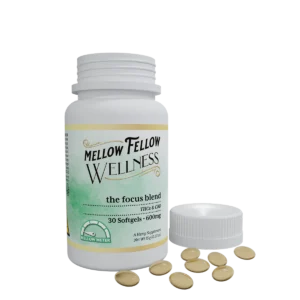
For most people starting with THCv for focus, the softgel is the simplest entry point. The Focus Blend Softgels deliver 600mg of cannabinoids across 30 softgels, or roughly 20mg per capsule, pairing THCv for mental sharpness with CBD for calm.
The softgel format gives steady, predictable absorption through the day, which suits long work sessions better than a fast spike. It is currently on sale and in stock, and because it is a swallowed capsule there is nothing to measure or refill.
Ways to Take THCv
Different routines call for different formats, so it helps to mix and match:
- For Set-and-Forget Focus: The Focus Blend softgels give a consistent daily dose without any prep.
- For Adjustable Dosing: Browse the wellness softgels collection to compare strengths and blends.
- For Calm-Forward Days: The CBD collection pairs well with THCv when you want more relaxation in the mix.
- For the Full Range: The THCv collection gathers vapes, gummies, and tinctures in one place.
Why the Mellow Fellow Approach Works
Generic THCv products vary batch to batch, which makes consistent focus hard to reach. Mellow Fellow uses pharmaceutical-grade formulation and posts certificates of analysis for every batch, so the dose you take today matches the one you took last week.
That consistency is the point. Reliable focus support depends on reliable dosing, and the Focus Blend softgels are built for exactly that.
Is THCv Safe and Legal?
THCv has a favorable early safety profile, but a few practical points are worth knowing before you add it to your routine.
Side Effects and Safety
In the human trials above, THCv was well tolerated, with mild and infrequent side effects such as dry mouth or slight dizziness at higher doses. Because it can reduce appetite in some people, anyone managing low body weight should approach it carefully.
Start with a low dose, and if you take medication or have a health condition, talk to a qualified medical professional first. THCv is a supportive option, not a treatment.
Legality and Drug Testing
Hemp-derived THCv sits under the 2018 Farm Bill framework, which legalized hemp cannabinoids as long as the final product stays at or below 0.3% Delta 9 THC by dry weight. State rules vary, so check your state before buying and review the shipping restrictions page.
On testing, standard screens look for THC metabolites, and because THCv is structurally similar it may trigger a positive result. If a test is coming up, it is safest to avoid THCv and other hemp cannabinoids.
Conclusion
THCv earns its place in a focus routine because it does something most options cannot: it supports alert, clear-headed energy without the intoxication of THC or the crash of caffeine. The receptor science and early human safety data back up the clear-headed profile, even if large focus-specific trials are still ahead.
Used with a low-and-slow mindset, THCv can be a steady daytime ally for productivity, especially when paired with CBD for balance. Match the format to your schedule, keep the dose modest, and pay attention to how you respond.
Ready to put THCv to work for your focus? Try our pharmacist-formulated Focus Blend softgels for lab-tested THCv and CBD in one steady daily capsule, and check out the wider lineup at Mellow Fellow.
Frequently Asked Questions
These are the questions people ask most often before adding THCv to a focus routine.
Does THCv Actually Help With Focus?
Many users report clear-headed energy and steady attention from low-dose THCv, and the receptor science supports a non-sedating profile. Direct clinical trials on focus are still limited, so treat it as a supportive option rather than a proven result.
Is THCv Psychoactive or Will It Get Me High?
At low to moderate doses THCv is non-intoxicating and does not produce a traditional high. In a human pilot trial, participants could not tell it apart from placebo. Very high doses can shift its behavior, which is another reason to keep the amount low.
How Much THCv Should I Take for Focus?
Start with a low single-digit dose in the morning and wait to feel the effect before taking more. The clear-headed benefits live at the low end, so more is not better for focus.
THCv vs Caffeine: Which Is Better for Focus?
THCv tends to feel smoother, with fewer jitters and less of a crash, while caffeine gives a sharper spike. Some people use a low dose of each together to balance the two.
Can I Take THCv and CBD Together for Focus?
Yes, and the pairing is popular. CBD calms mental noise while THCv adds alertness, which is why blends like the Focus Blend softgels combine them.
How Long Does THCv Take to Work for Focus?
Vapes act within 5 to 15 minutes, tinctures within 15 to 45 minutes, and softgels or gummies in about 45 to 90 minutes with longer-lasting effects.
Is THCv Legal?
Hemp-derived THCv is federally legal under the 2018 Farm Bill when the product stays at or below 0.3% Delta 9 THC by dry weight, but state laws vary, so check yours before buying.
Will THCv Show Up on a Drug Test?
It might. Standard tests screen for THC metabolites, and THCv is structurally similar enough that it could cross-react. Avoid it before a scheduled test.
Sources
- The cannabinoid Δ9-tetrahydrocannabivarin (THCV) ameliorates insulin sensitivity in two mouse models of obesity
- Efficacy and Safety of Cannabidiol and Tetrahydrocannabivarin on Glycemic and Lipid Parameters in Patients With Type 2 Diabetes
- The effect of five day dosing with THCV on THC-induced cognitive, psychological and physiological effects in healthy male human volunteers
- Δ9-Tetrahydrocannabivarin (THCV): a commentary on potential therapeutic benefit for the management of obesity and diabetes
- Tetrahydrocannabivarin (THCV) Dose Dependently Blocks or Substitutes for Tetrahydrocannabinol (THC) in a Drug Discrimination Task in Rats
- The role of tetrahydrocannabivarin (THCV) in metabolic disorders: A promising cannabinoid for diabetes and weight management