
What Is THCv? Effects, Benefits, and How It Works
Quick Answer: THCv (tetrahydrocannabivarin) is a naturally occurring cannabinoid found in cannabis that produces clear-headed, energizing effects without the typical THC high at standard doses. Unlike THC, it suppresses appetite rather than stimulating it, and early research suggests it may support metabolic health, focus, and emotional regulation.
THCv is one of the most talked-about cannabinoids right now, known for its clear-headed energy and appetite-suppressing effects. Here is how it works and what to expect.
Key Takeaways
- THCv stands for tetrahydrocannabivarin, a minor cannabinoid structurally similar to THC but with a shorter carbon side chain.
- At low doses, THCv is non-intoxicating; at high doses, it may produce a mild, short-lived psychoactive effect.
- THCv suppresses appetite by blocking CB1 receptors – the opposite of what THC does
- Research points to potential therapeutic uses in metabolic health, diabetes management, and neuroprotection.
- African sativa strains like Durban Poison carry the highest natural THCv content of any widely available cannabis varieties.
- Mellow Fellow’s THCv products combine it with complementary cannabinoids for reliable, lab-tested effects.
What Does THCv Stand For?
THCv stands for tetrahydrocannabivarin, a phytocannabinoid produced naturally in the cannabis plant. The name signals its structural relationship to THC (tetrahydrocannabinol), but that single-letter suffix – the “v” for varin – marks a meaningful chemical difference.
THCv has a propyl side chain (three carbons) rather than the pentyl chain (five carbons) found in THC. That shortened chain changes how the molecule binds to receptors in the endocannabinoid system, which in turn changes its effects on the body.
The molecular formula for THCv is C₁₉H₂₆O₂, compared to THC’s C₂₁H₃₀O₂. Two fewer carbon atoms. The result is a cannabinoid that behaves quite differently from its more famous cousin. For a broader look at where THCv fits among other rare compounds, our rare cannabinoids guide is a good starting point.
How Does THCv Work in the Body?
The endocannabinoid system (ECS) regulates mood, appetite, pain, immune response, and energy balance through two primary receptor types: CB1 and CB2. Most psychoactive cannabinoids act as agonists at CB1 receptors, binding and activating them to produce intoxicating effects.
THCv is different. At low to moderate doses, it acts as a CB1 antagonist – blocking, rather than activating, the receptor. This is the mechanism behind its appetite-suppressing and non-intoxicating properties. At high doses, the dynamic shifts and THCv can behave more like a partial CB1 agonist, producing a short-lived, clear-headed buzz.
THCv also interacts with CB2 receptors, which are concentrated in immune tissue. A recent study confirmed that THCv behaves as a potent CB2 partial agonist in vitro, which may contribute to its anti-inflammatory and neuroprotective potential.
Because THCv is typically present in trace concentrations in most strains, most users encounter it as part of a multi-cannabinoid blend rather than in isolation. That context matters for understanding its effects.

Browse the full THCv collection at Mellow Fellow.
Is THCv Psychoactive?
Yes and no – and that distinction is worth understanding clearly.
THCv is psychoactive in the technical sense: it crosses the blood-brain barrier and influences brain function. What it does not do at standard doses is produce the intoxicating “high” most people associate with THC.
At low doses, THCv’s CB1 antagonism keeps it non-intoxicating. Users typically report increased alertness, a cleaner sense of focus, and reduced mental fog. At higher doses, those antagonist properties can flip, and THCv may produce a mild, fast-onset psychoactive effect that tends to be shorter in duration than a comparable THC experience.
This dose-dependent behavior is part of why THCv earned the nickname “weederall” – the low-dose experience resembles stimulant-like clarity without the impairment associated with traditional THC products. For more on how that focus profile plays out in practice, see our post on THCv and ADHD-style focus benefits.
THCv Effects: What to Expect
THCv effects at typical product doses include:
- Increased Mental Clarity and Focus – users report sharper attention without agitation
- Energy and alertness – stimulating rather than sedating, suited to daytime use
- Appetite Suppression – distinct from most cannabinoids, THCv reduces hunger rather than triggering it
- Reduced Anxiety – early research and user reports suggest it may blunt THC-induced anxiety when combined
- Short Onset and Duration – effects from vapes tend to appear within minutes; duration is often shorter than equivalent THC doses

THCv onset time via inhalation is typically 5-15 minutes, similar to other cannabinoids in vapor form. Edibles and tinctures take longer – expect 45 to 90 minutes for full onset. Duration varies by dose and individual metabolism, but many users find the effects of THCv resolve faster than Delta 9 THC.
THCv vs Other Cannabinoids
Let’s take a look at how THCv compares to other notable cannabinoids.
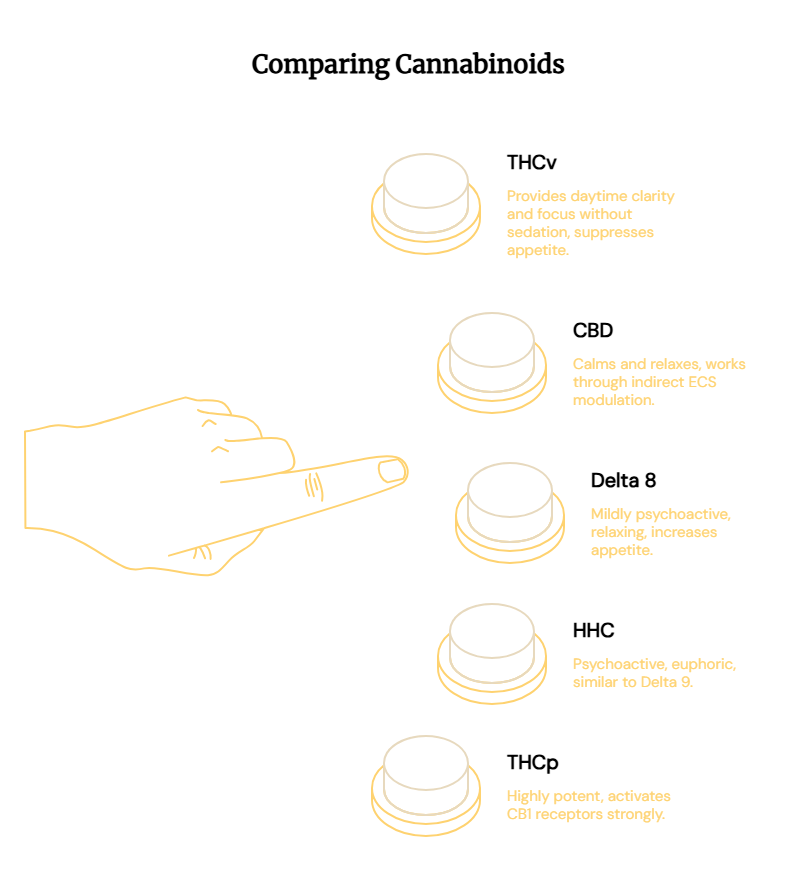
THCv vs CBD: Both are non-intoxicating at typical doses, but the experience is nearly opposite in character. CBD tends to calm and relax; THCv tends to energize and sharpen focus. CBD works largely through indirect ECS modulation and serotonin receptors, while THCv directly blocks CB1. If you want daytime clarity without sedation, THCv is the closer fit.
THCv vs Delta 8: Delta 8 THC is mildly psychoactive with a relaxing, lower-anxiety profile. THCv at standard doses produces no significant high. Delta 8 can increase appetite; THCv suppresses it. They serve different purposes and are rarely substituted for each other. Our Delta-8 vs Delta 9 explainer covers the Delta 8 side of that comparison.
THCv vs HHC: HHC (hexahydrocannabinol) is psychoactive and produces euphoric effects more similar to Delta 9 than THCv does. For a focused, clear-headed daytime experience, THCv is the better fit over HHC.
THCv vs THCp: THCp is one of the most potent cannabinoids known, binding CB1 receptors with significantly greater affinity than Delta 9 THC. THCv and THCp sit at nearly opposite ends of the potency spectrum – THCv blocks CB1 where THCp strongly activates it.
Browse the full THCv collection.
THCv for Weight Loss and Metabolic Health
The appetite-suppressing properties of THCv have drawn real scientific attention. A 2016 randomized, double-blind, placebo-controlled trial published in Diabetes Care by Jadoon et al. examined THCv in 62 patients with non-insulin-treated type 2 diabetes over 13 weeks.
Compared to placebo, THCv significantly decreased fasting plasma glucose and improved pancreatic beta-cell function, adiponectin, and apolipoprotein A concentrations. The authors concluded that THCv warrants further investigation as a therapeutic agent in glycemic control.

A 2013 preclinical study published in Nutrition & Diabetes found that THCv reduced glucose intolerance and improved insulin sensitivity in two mouse models of obesity – one diet-induced and one genetic. The researchers noted THCv’s CB1 antagonism as the likely mechanism.
This does not mean THCv is a weight loss drug. The science is early, doses tested in clinical settings differ from what’s available in commercial products, and individual responses vary.
Still, the pattern of evidence is consistent: THCv discourages overeating, supports metabolic signaling, and does not produce the sedation that limits other cannabinoids during productive hours. For a broader look at appetite and cannabinoids, our post on which THC is an appetite suppressant covers more ground.
THCv Research to Know
Beyond metabolic health, THCv research has explored several therapeutic directions.
Neuroprotection: A 2011 study, found that THCv attenuated motor inhibition and preserved dopaminergic neurons in two animal models of Parkinson’s disease. The researchers attributed these neuroprotective effects to THCv’s antioxidant properties and CB2 receptor activation.
CB1 and CB2 Receptor Pharmacology: A foundational pharmacology review by Pertwee et al. in the British Journal of Pharmacology confirmed that THCv acts as a potent CB2 partial agonist in vitro while antagonizing CB1 at lower doses, giving it a distinct receptor profile from either THC or CBD.
Insulin Sensitivity in Obesity Models: The Nutrition & Diabetes preclinical study referenced above also found that THCv improved insulin signaling in liver cells and reduced fasting glucose across both mouse models, reinforcing its metabolic potential.
These areas remain at early or preclinical stages for the most part. More research is needed before clinical conclusions can be drawn, and anyone considering THCv for a specific health condition should consult a qualified medical professional.
High THCv Strains: Where It Comes From Naturally
THCv occurs in relatively low concentrations in most cannabis strains, which is part of why it qualifies as a minor cannabinoid. The richest natural sources tend to be African sativa landraces – strains adapted to equatorial climates over generations.
|
Strain |
THCv Content (approx.) |
Type |
Notes |
|
Durban Poison |
0.2-1.8% |
Sativa |
Most widely cited high-THCv strain |
|
Pineapple Purps |
Up to 3% |
Sativa |
Bred for elevated THCv content |
|
Doug’s Varin |
Up to 6% |
Sativa |
Purpose-bred for maximum THCv |
|
Jack the Ripper |
0.3-1% |
Sativa-dominant hybrid |
Terpinolene-forward, energizing |
|
Girl Scout Cookies |
Trace-0.2% |
Hybrid |
Lower content, widely available |
Commercial products containing meaningful THCv doses typically use extraction and concentration processes rather than relying on whole-flower content. This is why lab-tested THCv products are a more reliable option for users seeking consistent effects.
Looking for a product that pairs THCv with a complementary strain? Our best sativa strains for focus post gives useful context on strain selection for energy-forward experiences.
Is THCv Legal?
Hemp-derived THCv falls under the federal framework of the 2018 Farm Bill, which legalized hemp and its cannabinoids as long as the final product contains no more than 0.3% Delta 9 THC by dry weight. THCv produced from compliant hemp is federally legal under this standard.
State law varies. A small number of states have passed restrictions on specific cannabinoids or hemp-derived psychoactive compounds. Before purchasing, check your state’s current hemp regulations. Mellow Fellow’s shipping restrictions page reflects current limitations on where products can be shipped.
Will THCv Show Up on a Drug Test?
This is a practical concern worth addressing directly. Standard drug tests screen for THC metabolites, not specific cannabinoids. Because THCv is structurally similar to THC, it may produce metabolites that cross-react with these screens.
The data on how reliably THCv triggers a positive result is limited. To be cautious: if a drug test is upcoming, avoid THCv and other hemp-derived cannabinoids. Our guide on what Delta-8 users should know before a drug test covers the broader picture for hemp-derived cannabinoids.
THCv Side Effects and Safety
Available evidence suggests THCv has a favorable safety profile at moderate doses, though research specific to long-term human use is limited. In the Jadoon 2016 clinical trial, THCv at 5 mg twice daily for 13 weeks was well tolerated with no new safety concerns identified. Reported side effects at higher doses are generally mild and may include:
- Dry mouth
- Mild dizziness at elevated doses
- Potential short-lived psychoactive effects when consumed in large quantities
Because THCv can suppress appetite, users managing low body weight or nutritional deficits should approach it cautiously. Combining THCv with other cannabinoids can modulate effects – pairing it with Delta-8 or HHC may balance THCv’s stimulating character with a calmer baseline.
Always start with a low dose when trying THCv for the first time and adjust gradually. For general dosing principles across cannabinoids, our Delta 9 THC dosage guide outlines a useful framework.
Mellow Fellow THCv Products
Mellow Fellow formulates THCv into multi-cannabinoid blends designed for specific effects. All products are pharmacist-formulated, lab-tested, and batch-tracked. You can review third-party results on the testing page before you buy.
Browse the full THCv collection or start with one of these picks:

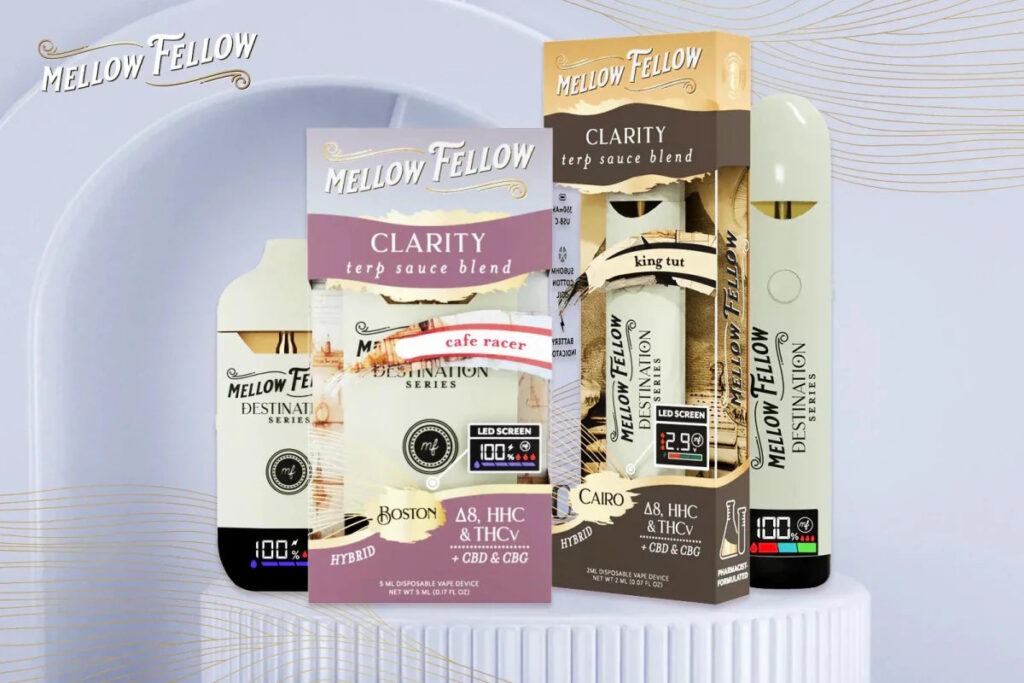
- Clarity Blend – Terp Sauce 2ml Disposable Vape, King Tut (Hybrid) A fast, portable option for users who want THCv’s focus-forward effects on the go. The King Tut profile delivers clean, uplifting vapor suited to daytime use.
- Clarity Blend – Terp Sauce 5ml Disposable Vape, Cafe Racer (Hybrid) More reservoir for extended use. Cafe Racer’s hybrid character balances the sharpening THCv with mild HHC body warmth.
- Clarity Blend 1ml Live Resin Vape Cartridge – Kush Mints (Hybrid) A cartridge option with live resin-preserved terpenes for fuller flavor and a more complete cannabinoid profile. Kush Mints adds cool, minty depth to the clarity-focused blend.
- Charged Blend 2ml Live Resin Vape Cartridge – Wedding Crasher (Hybrid) For users who want more stimulation alongside the focus effects. The Charged Blend pairs THCv with H4CBD and HHC for a lively, social-leaning experience.
- The Energy Blend – 1500mg Wellness Gummies, Tropic Medley An edible option for users who prefer gradual onset and longer duration. Formulated for energy and metabolic support, with consistent servings.
- The Focus Blend – 600mg Wellness Gummies, Tropic Medley A lower-dose entry point for users new to THCv-based gummies. Designed for productivity without overstimulation.
Ready to try a focus-forward cannabinoid? Browse the full THCv collection for current picks that ship to most states.
Sources
- The diverse CB1 and CB2 receptor pharmacology of three plant cannabinoids: Δ9-tetrahydrocannabinol, cannabidiol and Δ9-tetrahydrocannabivarin – PMC
- Efficacy and Safety of Cannabidiol and Tetrahydrocannabivarin on Glycemic and Lipid Parameters in Patients With Type 2 Diabetes: A Randomized, Double-Blind, Placebo-Controlled, Parallel Group Pilot Study | Diabetes Care | American Diabetes Association
- Symptom‐relieving and neuroprotective effects of the phytocannabinoid Δ9‐THCV in animal models of Parkinson’s disease – García – 2011 – British Journal of Pharmacology – Wiley Online Library
- The cannabinoid Δ9-tetrahydrocannabivarin (THCV) ameliorates insulin sensitivity in two mouse models of obesity | Nutrition & Diabetes
- The diverse CB1 and CB2 receptor pharmacology of three plant cannabinoids: Δ9‐tetrahydrocannabinol, cannabidiol and Δ9‐tetrahydrocannabivarin – Pertwee – 2008 – British Journal of Pharmacology – Wiley Online Library
Leave a Reply