
Should I Take CBD at Night or in the Morning?

Quick Answer: There’s no single correct time to take CBD. Morning use may support calm focus and daytime stress relief, while nighttime use tends to work better for relaxation and sleep. The best time depends on your goal, your chosen format, and how your body responds. Most people find consistency matters more than the exact hour.
Taking CBD has become part of a lot of daily routines, but the question of when to take it trips up beginners and experienced users alike. Should it go into your morning coffee ritual or your wind-down routine before bed? The timing shapes how CBD fits into your day and whether it delivers the benefits you’re after.
This guide breaks down morning versus nighttime CBD use, covers how different formats change your timing options, and maps out a practical daily CBD routine that you can adjust to your own goals. Whether you’re managing daytime anxiety, looking for better sleep, or just trying to keep a consistent wellness habit, you’ll find clear, usable guidance below.
Key Takeaways
- CBD timing depends on your goal: morning use tends to support calm focus, while evening use supports relaxation and sleep onset.
- Format matters as much as timing. Vapes and tinctures act within 15 to 45 minutes; edibles and capsules take 45 to 90 minutes and last longer.
- A 2024 randomized controlled trial in Journal of Clinical Sleep Medicine found that 150 mg of nightly CBD improved objective sleep efficiency by 6.85% compared to placebo after two weeks.
- A systematic review of 11 randomized controlled trials found that CBD may reduce anxiety symptoms with minimal adverse effects compared to placebo.
- Mellow Fellow’s CBD wellness lineup includes daytime, evening, and nighttime formats so you can match format to goal without guessing.
Morning vs. Night: What Are You Trying to Accomplish?
Before choosing a time, nail down your primary reason for taking CBD. The two most common scenarios point in opposite directions.
If your goal is to start the day with less tension, reduce morning anxiety, or maintain steady focus through a workday, morning CBD is a reasonable choice. Cannabidiol works in part through the endocannabinoid system, which plays a role in regulating mood, stress response, and attention. Research published in Cannabis and Cannabinoid Research found that a 600 mg dose of CBD reduced anxiety in participants with social anxiety disorder before a public speech compared to placebo, with reductions in anxiety correlating with decreased activity in brain regions associated with fear. While that dose is higher than most daily products, the directional effect on anxious arousal is consistent across lower-dose research as well.
If your primary goal is sleep support, winding down after a stressful day, or managing evening discomfort, nighttime CBD tends to be the better fit. A 2024 pilot trial published in Journal of Clinical Sleep Medicine examined 150 mg of sublingual CBD taken 60 minutes before bed in adults with moderate-to-severe insomnia. Compared to placebo, the CBD group showed superior objective sleep efficiency after two weeks and reported greater overall well-being throughout the trial. Participants also noted elevated alertness scores following wake – a signal that sleep quality, not just duration, may improve with consistent nightly use.
Neither time is categorically better. Many people eventually split their dose, taking a smaller amount in the morning for daytime stress management and a larger amount in the evening for sleep. Start with one goal, establish consistency, then adjust.
How CBD Format Changes Your Timing Options
The format you choose controls how quickly you feel CBD’s effects and how long they last. Getting format right is just as important as picking morning versus night.
A 2023 review on CBD pharmacokinetics published in International Journal of Molecular Sciences confirmed that oral bioavailability for standard CBD capsules and edibles sits around 6 to 13%, with onset ranging from 30 minutes to two hours depending on whether you’ve eaten recently. Sublingual delivery – holding a tincture under your tongue for 60 to 90 seconds – bypasses the first-pass liver metabolism and reaches the bloodstream faster. Inhaled CBD via a disposable vape offers the fastest onset, typically 5 to 15 minutes, at the cost of shorter overall duration.
The table below maps common formats to realistic timing windows:
| Format | Onset Time | Duration | Best Time of Day |
| CBD disposable vape | 5–15 min | 1–3 hours | Morning or as-needed |
| CBD tincture (sublingual) | 15–45 min | 4–6 hours | Morning or 1 hour before bed |
| CBD gummies / edibles | 45–90 min | 6–8 hours | 1–2 hours before target effect |
| CBD softgel capsules | 60–120 min | 6–8 hours | Morning or early evening |
| CBD topicals (roll-ons) | 15–30 min (local only) | 2–4 hours | Any time |
For sleep support, plan backwards from your target bedtime. If you want effects at 10 PM and you’re using gummies, take them around 8:30 PM. If you’re using a tincture, 9 PM works. A vape can be used closer to lights-out if you need something fast.
For daytime anxiety and focus, a vape or tincture fits most morning routines since effects arrive before your commute or first meeting, without lasting so long they interfere with afternoon energy. If you’d rather not vape in the morning, a softgel taken with breakfast will generally reach peak levels by mid-morning.
Taking CBD in the Morning: What to Expect
Morning CBD is a reasonable choice for people dealing with daily anxiety, work stress, or low-grade tension that starts as soon as the alarm goes off. CBD does not create the alertness buzz that caffeine does, but many users report that it takes the edge off anxious mornings without sedation. That calm-but-clear quality is what makes a morning dose useful.
A systematic review published in Life (2024) analyzed 11 randomized controlled trials of CBD for various anxiety disorders and found evidence suggesting CBD may reduce anxiety with minimal adverse effects compared to placebo. The review noted that dosing varied widely across studies, and that effects were not uniformly linear, meaning more isn’t always better. Starting low (10 to 25 mg for most beginners) and monitoring your response over one to two weeks is more reliable than chasing a number.
One practical note: if you take CBD with breakfast, the fat content of your meal can significantly increase bioavailability. A meal with eggs, avocado, or nut butter will absorb more CBD than plain coffee or water. This applies mainly to edibles and capsules; sublingual tinctures and vapes bypass digestive absorption.
For a clean morning experience, the Happy Blend 1 mL CBD Disposable Vape in Cotton Candy delivers fast-onset hemp-derived CBD in a compact, no-fuss format. It’s a good fit for people who want effects within minutes rather than waiting out an edible’s delay. Pair it with the Momentum Blend Wellness Gummies later in the day for sustained support through afternoon.
You might also want to compare how CBD stacks up against other minor cannabinoids for specific goals. Our guide on CBG vs. CBD for anxiety and calming breaks down the functional differences in detail.
Taking CBD at Night: Sleep, Recovery, and Wind-Down
Evening CBD is where the research gets more interesting and where most people find their biggest results. Sleep support, relaxation, and recovery from physical activity are all areas where a nightly CBD habit has shown measurable benefit in recent clinical work.
The 2024 CBD-terpene formulation trial published in Journal of Clinical Sleep Medicine studied 125 people with insomnia over four weeks. Participants taking an oral CBD preparation with co-administered terpenes including linalool, myrcene, and beta-caryophyllene reported improvements in sleep onset and sleep quality compared to placebo. Terpenes like linalool are already associated with calming effects on their own, and the combination appears to compound the benefit. This is part of why full-spectrum CBD products – which retain naturally occurring terpenes – are often preferred for sleep applications over isolate-based options.
Separately, a 2024 systematic review of CBD for pain published in Pharmaceuticals (Basel) concluded that there is sufficient clinical and preclinical evidence to support CBD as an effective and safe option in reducing pain. Evening use for pain is especially logical: discomfort that builds through the day tends to peak in the evening, and having CBD active during those hours supports both comfort and the ability to fall asleep.
For physical recovery specifically, our dedicated guide on CBD for recovery covers the timing and format considerations in more detail.
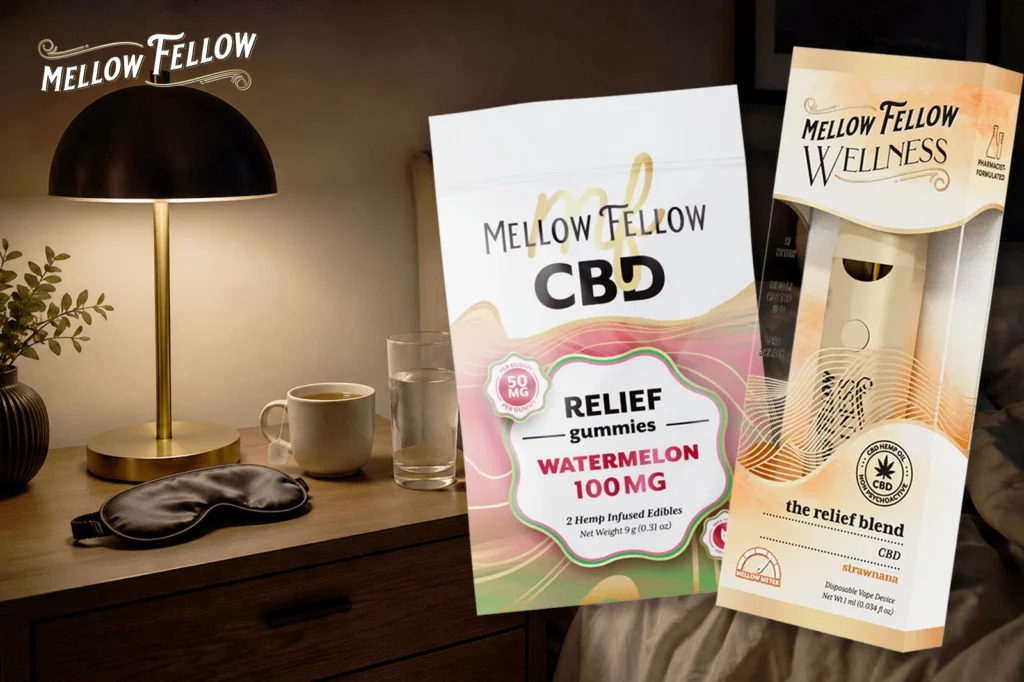
The Rest Blend 1 mL CBD Disposable Vape and the Relief Blend CBD Vape in Strawnana are built specifically for evening and pre-sleep use. Both offer fast onset and simple, low-fuss dosing – a single short pull is all most users need to start feeling the shift. The Relief CBD Gummies 1,500 mg Watermelon work better for people who prefer a slower, longer-lasting effect window through the night.
The Best CBD Products for Morning vs. Night
Matching the right product to the right time of day makes the difference between CBD that actually works for your goal and CBD that feels like nothing is happening. Here’s a practical breakdown of the Mellow Fellow CBD wellness collection by use case.
Daytime Options:
- Happy Blend 1 mL CBD Disposable Vape (Cotton Candy): Fast onset (5–15 min), clean and uplifting profile, no delay. Good for anxious mornings or as-needed stress relief during the day. Shop here.
- Momentum Blend Wellness Gummies (1,500 mg, Tropic Medley): A longer-duration edible designed for sustained daytime wellness support. Take with breakfast for mid-morning peak. Shop here.
- Illuminate Blend Softgel Capsules (600 mg, 30 ct): Precise and consistent dosing in capsule form. Ideal for people who prefer tasteless, measured servings without the variability of gummies. Shop here.
Evening and Nighttime Options:
- Rest Blend 1 mL CBD Disposable Vape (Vanilla): Designed for pre-sleep use. Fast onset means you can use it close to lights-out without planning ahead. Shop here.
- Relief Blend 1 mL CBD Disposable Vape (Strawnana): Great for evening discomfort and physical wind-down. Strawnana’s terpene character pairs naturally with a rest-focused goal. Shop here.
- Relief CBD Gummies 1,500 mg (Watermelon): A slower, longer-lasting edible option ideal for people who want CBD to carry them through the full night rather than just the first hour. Shop here.
Flexible / Any Time:
- Delta-9 THC + CBD Seltzers: Mellow Fellow’s drinks collection features nano-emulsified beverages with CBD and low-dose Delta-9 THC, designed for faster onset than standard edibles. The Strawberry Mango Seltzer, Blue Raspberry Seltzer, Pineapple Orange Seltzer, and Blackberry Lemon Seltzer all use nano-emulsification for faster absorption compared to oil-based edibles. These work morning, afternoon, or evening depending on how your body responds to the cannabinoid combination.
How to Build a Daily CBD Routine
Timing is one variable. Consistency is the bigger one. Most of the clinical research on CBD looks at effects over two to four weeks of daily use, not single doses. Building a repeatable routine is what lets CBD do its job.
Here’s a framework to start from and adjust as you learn your response:
- Decide on one primary goal first. Sleep, morning anxiety, or daytime stress each points to a different time window. Don’t try to optimize for all three at once in the first two weeks.
- Pick a format that matches your timeline. Use the onset table above as your starting point.
- Start at a low dose. 10 to 25 mg is a reasonable starting range for most adults. Give your body a week to adjust before raising it.
- Take it at the same time each day. Consistency helps you track results and keeps cannabinoid levels more stable.
- Log how you feel. A simple journal entry after three to five days helps you notice patterns – when you feel more relaxed, when sleep quality shifts, when morning tension eases.
After two weeks of consistency, reassess. If morning CBD is helping but you’re still struggling to sleep, consider adding a small evening dose of a different format. If nighttime CBD is working but afternoons are rough, a midday vape or tincture might be the add.
For people wondering whether CBD stacks well with THC, our article on whether you can mix CBD and THC covers the interaction and what it means for timing decisions.
CBD Timing by Specific Goal
Not every user fits a simple morning or night category. Here’s a practical timing guide organized by specific intent:
| Goal | Recommended Timing | Best Format |
| Morning anxiety and stress relief | 30–60 min after waking | Tincture or vape |
| Work focus and calm | Before starting your workday | Tincture or capsule with breakfast |
| Afternoon stress / midday reset | As needed, 2–3 PM | Vape or tincture |
| Post-workout recovery | Within 1 hour after exercise | Gummies or tincture |
| Evening wind-down | 1–2 hours before bed | Gummies or tincture |
| Sleep onset support | 30–60 min before bed | Tincture, vape, or fast-onset edible |
| Nighttime discomfort / staying asleep | 1.5–2 hours before bed | Gummies or capsule |
| Topical pain relief | As needed | Roll-on or cream |
For targeted topical use, the best CBD cream for tendon pain guide walks through format options and application tips for localized relief without a whole-body dose.
Can You Take CBD in the Morning and at Night?
Yes. Splitting a daily CBD dose into two smaller servings – one in the morning, one in the evening – is a common and well-tolerated approach. It keeps cannabinoid exposure more consistent across the day without requiring a single large dose at once.
If you’re taking 25 mg per day and seeing modest effects, splitting to 15 mg in the morning and 10 mg before bed (or reversing the ratio depending on your primary goal) is a reasonable next step. The combination of different CBD spectrums and their timing implications is worth understanding before stacking cannabinoids, especially if you’re considering CBN for sleep on top of a daytime CBD routine.
There’s no clinical evidence suggesting that twice-daily dosing causes harm. Side effects of CBD are generally mild – dry mouth, drowsiness at higher doses, and transient appetite changes are the most commonly reported. If drowsiness is your concern with morning use, try a smaller morning dose (5 to 10 mg) and see whether that level produces calm without sedation.
One practical caution: if you take prescription medications, CBD can inhibit cytochrome P450 liver enzymes, which affects how the body processes certain drugs. Consult a healthcare professional before starting any CBD regimen if you take prescription medications regularly.
Should Beginners Take CBD at Night First?
A common recommendation is for first-time CBD users to start at night. The logic: if you take CBD for the first time during the day and find it makes you feel drowsy (which can happen at higher doses), you’ve affected your workday or driving safety. Starting at night, when you’re already winding down, lets you gauge how your body responds without the same stakes.
Start with a small dose – 10 mg is a reasonable beginning point. If you feel nothing, increase by 5 to 10 mg every three to four days until you notice the effect you’re after. This gradual titration approach is consistent with what most clinical trials use as a protocol.
Once you understand how CBD affects you at a given dose, moving it to the morning becomes a much lower-risk experiment.
Finding the Right CBD Products and Staying Consistent
The timing and format questions only matter if the products you’re using are reliably formulated. Lab-tested, batch-tracked CBD products with clear cannabinoid panels are the foundation of a consistent routine. Mellow Fellow publishes third-party lab results for its full lineup, so you always know what’s in the product you’re taking.
Browse the full CBD wellness edibles collection or the CBD disposable vapes to compare products side by side. If you’re also exploring how CBD interacts with other cannabinoids for specific goals, our guide on CBG vs. CBD for anxiety and calming is a useful next read.
Conclusion: Match Your Timing to Your Goal
The best time to take CBD is the time that matches your reason for taking it. Morning doses support calm focus, stress management, and daytime anxiety relief. Evening doses support relaxation, sleep onset, and physical recovery. Splitting the dose across both times of day is a practical middle ground for people managing multiple goals.
Format matters as much as timing. Vapes and tinctures work fast and suit time-sensitive situations. Gummies and capsules work slowly and provide longer coverage. Match the format to the window you’re trying to hit.
Start with one goal. Stay consistent for two weeks. Adjust from there.
Browse Mellow Fellow’s CBD wellness collection to find morning, evening, and anytime formats that fit your routine.
Frequently Asked Questions
Is It Better to Take CBD at Night or in the Morning?
Neither time is universally better. The right choice depends on your goal. For anxiety, stress, and daily focus, morning use tends to work better. For sleep, relaxation, and evening recovery, nighttime use is the stronger fit. Many people find that taking a smaller dose in the morning and a larger dose in the evening covers both needs.
How Long Before Bed Should I Take CBD?
Timing depends on the format. Tinctures: 45 to 60 minutes before bed. Gummies and capsules: 1.5 to 2 hours before bed. A CBD vape can be used 20 to 30 minutes before sleep. Taking it too early may mean effects wear off before you fall asleep; too late may mean effects haven’t kicked in yet when you need them.
Will CBD Make Me Tired During the Day?
At lower doses (10 to 25 mg), most users do not report sedation. Drowsiness is more common at higher doses (above 100 mg) and is dose-dependent. If morning CBD makes you feel groggy, reduce the dose and switch to a fast-acting format like a vape or tincture so you can assess effects more quickly and stop if needed.
Does CBD Give You Energy in the Morning?
CBD isn’t a stimulant and doesn’t produce the alertness boost that caffeine does. What many users describe is that it reduces anxious mental noise, which can feel like more mental clarity and ease of focus. Some users combine small-dose CBD with their regular morning coffee, finding the two complement each other without the jittery edge. Our article on full-spectrum vs. broad-spectrum CBD covers which formulation might suit a daytime focus goal.
How Much CBD Should I Take at Night for Sleep?
Most clinical trials have used doses between 25 mg and 300 mg for sleep-related outcomes. The 2024 pilot trial referenced in this article used 150 mg and showed improved sleep efficiency. Beginners should start at 10 to 25 mg, allow two weeks for the body to establish a baseline, and increase gradually. Product potency varies, so check the mg-per-serving label rather than comparing servings across brands.
How Much CBD Should I Take in the Morning?
A starting morning dose of 10 to 25 mg is appropriate for most adults. For ongoing stress and anxiety management, many users settle into a range of 15 to 50 mg depending on body weight and sensitivity. Start low, track your response, and increase only if you’re not seeing the calm, focused effect you’re after.
Can I Take CBD Twice a Day?
Yes. Twice-daily dosing is common and well tolerated. A split approach – smaller dose in the morning, larger dose in the evening – is a practical way to manage both daytime stress and nighttime sleep quality without relying on a single large dose.
Can You Take CBD on an Empty Stomach?
You can, but for edibles and capsules, fat-containing food significantly improves absorption. The lipophilic nature of CBD means it binds to dietary fats during digestion, increasing the amount that reaches your bloodstream. If you’re taking a tincture sublingually or using a vape, food isn’t as much of a factor since those routes bypass first-pass digestion.
Can I Take CBD with Coffee?
Many people do. There’s no clinical data showing that caffeine and CBD interact in a harmful way. Anecdotally, the combination is described as producing a focused alertness without the anxiety or jitteriness some people experience from coffee alone. Keep your coffee consumption consistent when you start CBD so you can isolate how the CBD itself is affecting you.
Should Beginners Start with CBD at Night?
Starting at night is a sensible approach for first-time users. If you experience unexpected drowsiness at your starting dose, it won’t affect your work or daily activities. Once you understand how a given dose affects you, moving to morning use is straightforward.
What Happens If I Take CBD Every Day?
Daily CBD use is common and generally well-tolerated. Research on long-term daily use in healthy adults shows a mild side effect profile: the most reported effects are dry mouth, mild changes in appetite, and occasional drowsiness at higher doses. Unlike THC, CBD does not produce tolerance in a way that requires escalating doses in most users. Some research suggests the endocannabinoid system may actually become more responsive to CBD with consistent use over time, though this area needs more study.
Is CBD Better for Sleep or Stress?
Research supports both applications, though the evidence is stronger and more consistent for anxiety than for sleep at lower doses. That said, many users find that addressing stress with morning CBD indirectly improves their sleep quality by reducing the anxious arousal that delays sleep onset. If you’re primarily dealing with sleep issues, a dedicated nighttime dose is still the clearest route.
Can CBD Help with Morning Anxiety?
Yes. Several clinical trials have found that CBD may reduce subjective anxiety, particularly in social and stress-induced contexts. Taking CBD 30 to 60 minutes before an anxiety-prone situation – a commute, a meeting, a difficult conversation – is a use pattern many people report finding effective. For a broader comparison of cannabinoid options for this goal, see our guide on CBG vs. CBD for anxiety and calming.
Can CBD Help You Sleep Better?
Clinical evidence suggests CBD may improve aspects of sleep quality, particularly sleep efficiency, rather than simply making you fall asleep faster. A 2024 clinical trial found improved objective sleep efficiency in participants using 150 mg of nightly CBD versus placebo. A separate 2024 CBD-terpene formulation trial in 125 people with insomnia found sleep-quality improvements over four weeks. Results are not universal, and individual response varies, but the direction of the evidence is reasonably consistent.
What Is the Difference Between Full-Spectrum and Broad-Spectrum CBD for Timing?
Full-spectrum products retain naturally occurring terpenes and minor cannabinoids alongside CBD. These compounds may contribute an entourage effect that many users find makes full-spectrum feel more effective at a given dose. Broad-spectrum removes THC while retaining other cannabinoids. CBD isolate contains only CBD. For nighttime sleep use, full-spectrum options are often preferred because sleep-supportive terpenes like linalool and myrcene are present alongside the CBD. For more detail, read our full-spectrum vs. broad-spectrum CBD guide.
Sources
- Cannabidiol for Moderate-Severe Insomnia: A Randomized Controlled Pilot Trial of 150 mg of Nightly Dosing (2024) https://pubmed.ncbi.nlm.nih.gov/38174873/
- Effects of a Cannabidiol/Terpene Formulation on Sleep in Individuals with Insomnia: A Double-Blind, Placebo-Controlled, Randomized, Crossover Study (2025) https://pmc.ncbi.nlm.nih.gov/articles/PMC11701282/
- The Impact of Cannabidiol Treatment on Anxiety Disorders: A Systematic Review of Randomized Controlled Clinical Trials (2024) https://pmc.ncbi.nlm.nih.gov/articles/PMC11595441/
- Potential Utility of Cannabidiol in Stress-Related Disorders (2023) https://pubmed.ncbi.nlm.nih.gov/36409719/
- Current Challenges and Opportunities for Improved Cannabidiol Solubility (2023) https://pubmed.ncbi.nlm.nih.gov/37833962/
- Cannabidiol (CBD): A Systematic Review of Clinical and Preclinical Evidence in the Treatment of Pain (2024) https://www.mdpi.com/1424-8247/17/11/1438
Meta Title: Should I Take CBD at Night or in the Morning? Timing Guide
Meta Description: Find out when to take CBD based on your goal. Compare morning vs. night timing, formats, doses, and top Mellow Fellow CBD picks.
Suggested URL Slug: should-i-take-cbd-at-night-or-in-the-morning
Leave a Reply