
What Are Kief-Coated Prerolls and How Strong Are They?
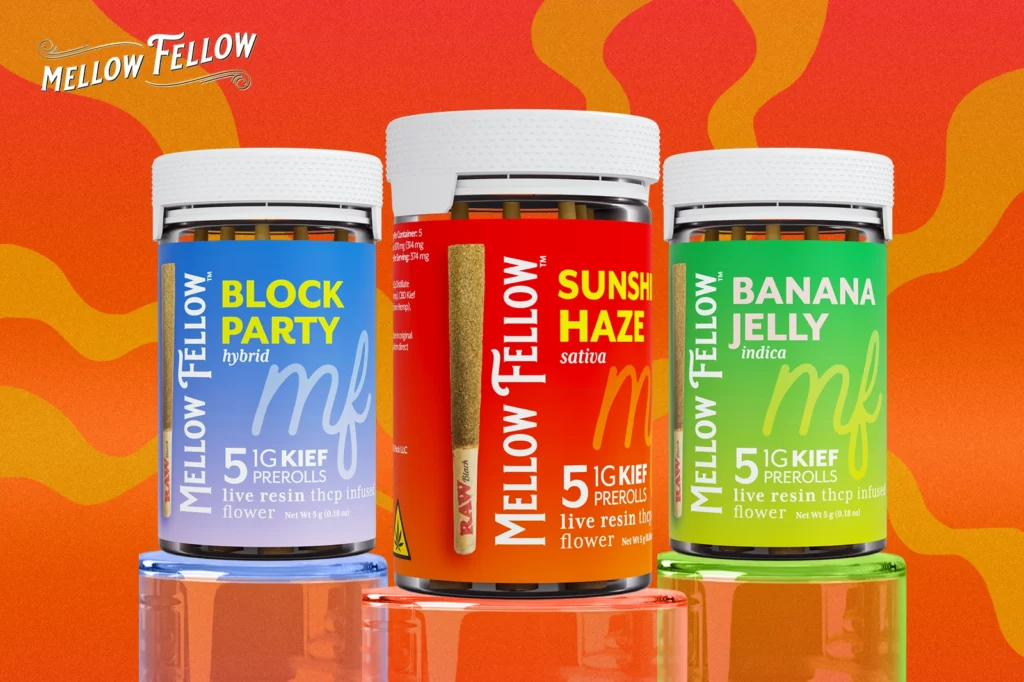
Quick Answer: Kief-coated prerolls are joints rolled in kief, the loose powder of cannabinoid-rich trichomes shaken from cannabis flower. That extra coating raises the cannabinoid load well past a plain joint. Mellow Fellow’s kief prerolls carry 374mg of cannabinoids per THCp gram and 545mg per THCa gram, so they hit harder and last longer than standard prerolls.
A regular joint is flower, paper, and a light. A kief-coated preroll adds one more layer: a dusting of kief packed onto the outside of the joint, sometimes with more mixed into the grind. That single change pushes cannabinoid content up sharply, which is exactly why people ask how strong these joints really are before lighting one.
The short version is that kief is concentrated plant resin, and resin is where cannabis stores almost all of its cannabinoids and terpenes. Coat a joint in it and you are adding a purer, denser dose on top of already potent flower. This guide breaks down what kief-coated prerolls are, what makes them stronger than ordinary joints, how THCa and THCp versions differ, and how to smoke one without wasting the good stuff.
Key Takeaways
- Kief is loose trichome resin, the part of the plant that holds most cannabinoids and terpenes.
- A kief coating raises total cannabinoid density far above the flower underneath it.
- Mellow Fellow THCp kief prerolls test at 374mg cannabinoids per 1g joint; THCa versions reach 545mg.
- THCa needs heat to activate, while THCp is already in its active form when you smoke it.
- Slow, patient smoking gets the most from the kief without harsh, uneven burns.
- Ready to feel the step up? See the kief prerolls at Mellow Fellow.
What Are Kief-Coated Prerolls?
A kief-coated preroll is a joint of ground flower that has been rolled in or dusted with kief before it is packed and sealed. The flower provides the base, and the kief adds a concentrated outer shell of resin that burns into the smoke as you work down the joint. Because the coating is nearly pure trichome material, the finished preroll delivers more cannabinoids per puff than the same flower rolled on its own.
These are a close cousin of infused prerolls, which use extracts like distillate, live resin, or budder instead of, or alongside, kief. If you want the wider category first, our overview of infused prerolls covers how added concentrates change the burn and the strength. Kief sits at the more natural end of that spectrum, since it is simply flower resin that has been separated and reapplied rather than chemically processed.
Mellow Fellow builds its kief prerolls in 5-count jars, with each joint holding a full gram of flower under the kief. That format keeps the flavor of the strain intact while the coating raises the cannabinoid count, which is the balance most seasoned smokers are after.
What Is Kief and Why Does It Boost Potency?
Kief is the fine, sandy powder that collects when trichomes break away from dried flower. Those trichomes are the tiny, mushroom-shaped glands that coat cannabis buds, and they are the plant’s chemistry factory. Research on cannabis biology describes the stalked glandular trichomes as the structures that produce and store the resin containing cannabinoids like THCa, along with the terpenes that carry aroma and flavor. Collect enough of those glands and you have kief.
Because kief is almost all resin, it is much denser in active compounds than the leafy plant matter around it. When that layer wraps a joint, every draw pulls smoke through a concentrated band of cannabinoids rather than through flower alone.
The result is a stronger joint that also tastes more of the strain, since terpenes ride along with the resin. For a deeper look at how these compounds interact, the Mellow Fellow guide to rare cannabinoids walks through THCp, THCa, and their less common relatives.
Kief is also the raw material behind other concentrates. Pressed and processed further, it can become hash or feed products like THCa budder. In a preroll, though, it stays loose and unpressed, which keeps handling simple while still delivering that concentrated punch.
How Strong Are Kief-Coated Prerolls?
Strength comes down to cannabinoid density, and this is where kief prerolls separate themselves from a plain joint. Many high-grade flower jars test somewhere in the high teens to mid-20s for THCa percentage. Mellow Fellow’s kief prerolls report total cannabinoid content per gram that lands well above that range, because the kief coating stacks extra resin on top of the flower base.
The table below shows the labeled cannabinoid content for each Mellow Fellow kief preroll. Serving size is one 1g joint, and each jar holds five.
| Product Line | Strain Type | Cannabinoids Per 1g Joint | Cannabinoids Per 5-Pack |
| THCp Kief Prerolls | Sativa, Hybrid, Indica | 374mg | 1870mg |
| THCa Kief Prerolls | Sativa, Hybrid, Indica | 545mg | 2725mg |
At 374mg per gram, the THCp joints sit near 37% total cannabinoids, and the THCa joints reach roughly 55% at 545mg. Both figures clear typical flower by a wide margin, which is the practical reason these prerolls feel stronger and run longer than a standard smoke.
Cannabinoid type matters as much as the raw number. THCp carries part of its reputation from a 2019 study that first isolated the compound and reported it binding the CB1 receptor about 33 times more effectively than THC in laboratory tests. That figure is an in vitro binding measurement, not a promise that the high is 33 times bigger, but it does help explain why small amounts of THCp can register strongly. Our THCp potency guide puts that research in context for everyday use.
Ready to feel that step up in a familiar format? Browse the THCp prerolls lineup and start with short pulls if you are new to this strength.
THCa vs THCp Kief Prerolls: How the Cannabinoids Differ
Both product lines use a kief coating, but the headline cannabinoid behaves differently in each. THCa is the acidic, non-intoxicating form the plant actually makes. On its own it does not produce a high, because in its raw state it does not bind well to the brain’s CB1 receptors, according to a review of THCa pharmacology that also notes THCa can make up as much as 90% of the total THC in a plant. Heat changes that.
When you light a THCa joint, combustion triggers decarboxylation, the reaction that strips a carbon dioxide group and converts THCa into active THC. Studies on cannabinoid decarboxylation kinetics show this conversion tracks closely with temperature, and the heat of a burning joint pushes it along in real time. If you want the science of that conversion in plain terms, see our breakdown of how to decarb THCa flower. THCp, by contrast, is already in its active, neutral form, so it engages CB1 receptors in the brain the moment it reaches you.
| Feature | THCa Kief Prerolls | THCp Kief Prerolls |
| Active when raw | No, needs heat | Yes |
| What activates it | Decarboxylation from the flame | Already active |
| Cannabinoids per 1g joint | 545mg | 374mg |
| Known for | Classic THC-style high after lighting | High CB1 affinity, strong at low amounts |
| Best for | Smokers who want familiar flower effects | Experienced smokers chasing intensity |
The takeaway is that a THCa joint delivers a traditional THC experience once heat does its job, while a THCp joint leans on a cannabinoid built for strength. Neither is a beginner product.
How Kief-Coated Prerolls Compare to Regular Prerolls
Set a kief-coated joint next to a standard one and the differences show up fast. A regular preroll relies on flower alone, so its strength is capped by the flower’s cannabinoid percentage. A kief coating removes that ceiling by adding concentrated resin on top. Our comparison of whether infused prerolls hit harder than regular ones reaches the same conclusion from a broader angle.
Here is how the two stack up in practice:
- Cannabinoid Density: Kief prerolls carry far more cannabinoids per gram than flower-only joints, so effects arrive faster and feel stronger.
- Flavor: The trichome coating adds terpenes, giving a fuller taste of the strain than plain flower usually offers.
- Burn Time: Denser resin tends to burn slower, so a kief joint often lasts longer per session.
- Onset: Smoking delivers cannabinoids through the lungs quickly, and inhaled THC is detectable in plasma within seconds, with peak levels reached within minutes according to cannabinoid pharmacokinetics research, so the added strength registers early.
- Best Audience: Regular prerolls suit casual sessions, while kief-coated joints fit smokers with a built-up tolerance.
If you are moving up from standard joints, treat a kief preroll as a stronger product and adjust how much you smoke in one sitting. See the full THCa prerolls lineup if you want the higher label reading in a joint.
Mellow Fellow Kief-Coated Prerolls to Try
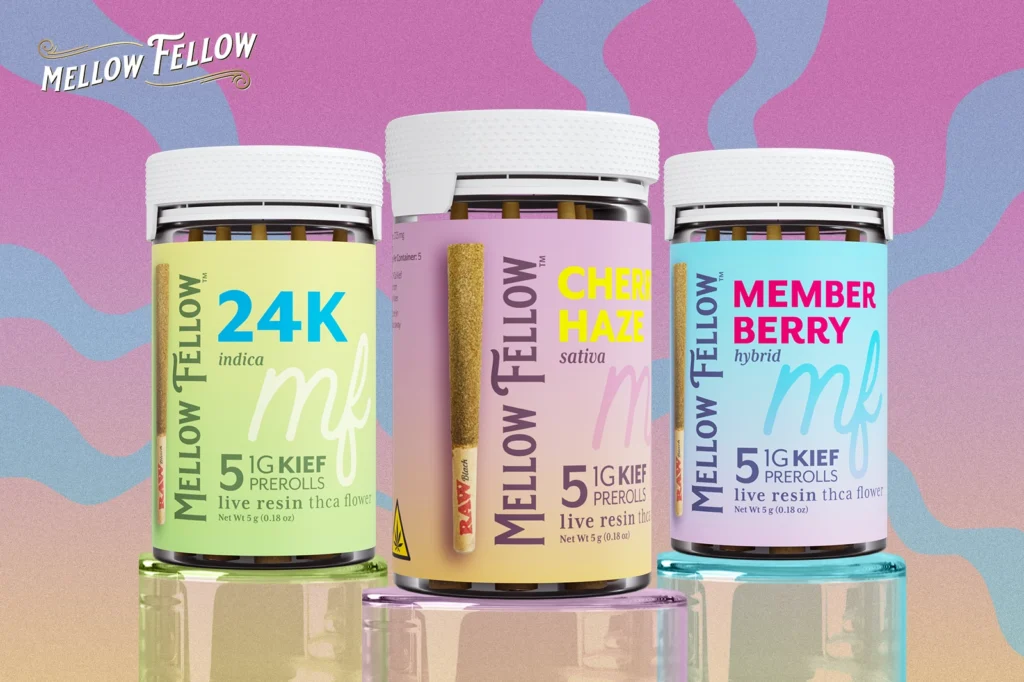
Mellow Fellow makes kief-coated prerolls better by starting with flavorful flower, then coating it in kief for a cleaner, denser draw instead of relying on heavy processing. Each jar holds five 1g joints, so you get repeatable dosing across a full pack. The THCp line runs at 374mg per joint and the THCa line at 545mg, and both come across the sativa, hybrid, and indica spread. The lineup spans both cannabinoids and all three strain types.
- For a bright, daytime sativa, the THCp Sunshine Haze kief prerolls lean citrusy and energizing, a solid wake-and-bake pick at 374mg per joint.
- If you want balance, the THCp Block Party hybrid kief prerolls pair a creative head lift with a full-body calm and a sweet berry and gas flavor.
- For winding down, the THCp Banana Jelly indica kief prerolls move from an early rush of euphoria into deep relaxation, with banana, cinnamon, and lavender notes.
- On the THCa side, which reads highest on the label at 545mg per joint, the THCa 24K indica kief prerolls deliver an uplifted mood with soothing relaxation and a sweet, skunky citrus profile.
- The THCa Member Berry hybrid kief prerolls open with a floaty euphoria before settling the body, wrapped in sweet and tart flavor.
- Rounding out the group, the THCa Cherry Haze sativa kief prerolls bring creative, uplifting energy with sweet cherry and a hint of spicy haze.
New to this category and still deciding? Check out the wider flower collection to compare formats before you commit to a full jar.
How to Smoke Kief-Coated Prerolls for the Best Experience
Kief burns differently from plain flower, so a little technique keeps the joint even and stops you from wasting resin. The coating can flare if you rush it, and it can clog airflow if you draw too hard, so slow and steady wins. Our full walkthrough on how to smoke an infused preroll covers the same handling ideas in more depth.
Keep these points in mind before you spark up:
- Light Gently: Toast the tip with a slow flame rather than a hard burn, so the kief melts in instead of flaring off.
- Draw Slowly: Short, easy pulls prevent clogging and keep the burn even down the joint.
- Pace Yourself: Given the cannabinoid load, wait between puffs to gauge the effect before taking more.
- Store It Upright: Keep unused joints cool and dry so the kief stays intact until you smoke.
- Mind Your Roll: If you ever roll your own, our tips on rolling a joint help the coating stay put.
Treat the first joint from a new jar as a tester. Note how much it takes to reach the effect you want, then repeat that amount next time.
Conclusion
Kief-coated prerolls take a familiar joint and load it with the strongest part of the plant, its trichome resin. That is why they read so high on the label and feel noticeably stronger than a regular preroll, with Mellow Fellow’s versions reaching 374mg of cannabinoids per THCp gram and 545mg per THCa gram.
THCa joints turn on with the heat of the flame, THCp joints arrive already active, and both reward a slower, more deliberate smoking style. For anyone with the tolerance to enjoy them, kief prerolls are among the most straightforward ways to smoke a high-strength joint without dealing with dabs or vapes.
Want to feel the difference for yourself? Shop the kief prerolls and heavier 2g blunts at Mellow Fellow, start with short pulls, and pace your session to the strength.
Frequently Asked Questions
Below are quick answers to the most common questions about kief-coated prerolls, their strength, and how they compare to other options.
What Are Kief-Coated Prerolls Made Of?
Kief-coated prerolls are joints of ground flower rolled in kief, the loose powder made of cannabinoid-rich trichomes shaken from cannabis buds. The flower forms the base, and the kief adds a concentrated outer layer of resin that raises the joint’s overall strength.
How Strong Are Kief-Coated Prerolls Compared to Regular Joints?
Kief-coated prerolls are considerably stronger than regular joints because the kief adds concentrated cannabinoids on top of the flower. Mellow Fellow’s kief prerolls test at 374mg of cannabinoids per gram for THCp and 545mg for THCa, well above the cannabinoid content of most flower alone.
Are THCa Kief Prerolls or THCp Kief Prerolls Stronger?
By raw cannabinoid weight, THCa kief prerolls read higher at 545mg per gram versus 374mg for THCp. THCp binds CB1 receptors far more efficiently in lab tests, so its strength comes from receptor activity rather than sheer quantity. Both are built for experienced smokers.
Do Kief-Coated Prerolls Get You Higher?
For most smokers, kief-coated prerolls produce stronger effects than plain flower joints because they contain more active cannabinoids per puff. THCa converts to active THC through the heat of the flame, while THCp is already active when smoked, so both deliver a potent result.
Is Kief the Same as Hash?
Kief and hash both come from trichomes, but they are not identical. Kief is the loose, unpressed powder of trichome heads, while hash is kief or resin that has been pressed and often heated into a solid concentrate. Kief-coated prerolls use the loose form.
How Should Beginners Approach Kief-Coated Prerolls?
New or low-tolerance smokers should treat kief-coated prerolls with caution given their strength. Take one or two short pulls, wait several minutes to judge the effect, and avoid finishing a full 1g joint in a single session until you know how it hits.
Sources
Endocannabinoid System: Chemical Characteristics and Biological Activity
A novel phytocannabinoid isolated from Cannabis sativa L. with an in vivo cannabimimetic activity higher than Δ9-tetrahydrocannabinol: Δ9-Tetrahydrocannabiphorol | Scientific Reports
Frontiers | Cannabis Glandular Trichomes: A Cellular Metabolite Factory