
Best Ways To Store Flower During the Summer Heat
Quick Answer: The best way to store cannabis flower in summer is in an airtight glass jar, kept between 60°F and 70°F, at 55% to 62% relative humidity, away from direct sunlight. Heat speeds up THC breakdown into CBN, UV light strips terpenes within days, and humidity above 65% invites mold, so a cool, dark, sealed jar is the single biggest upgrade most people can make this season.
Summer is hard on cannabis flower. A jar that sat happily on a dresser all winter can turn crumbly, foggy-smelling, or suspiciously soft the moment a heat wave rolls through, and a backpack or car console makes things worse. The trichomes that hold cannabinoids and terpenes are sensitive to temperature swings, light, and moisture in ways that are easy to underestimate until a batch of good flower stops tasting or feeling the way it did at pickup.
This guide breaks down exactly how heat, humidity, and light degrade cannabis flower, what temperature and humidity range actually protects potency, and how to handle real summer scenarios like hot cars, beach bags, and heat waves. You will also find a straightforward container and humidity pack setup that keeps flower fresh whether you are storing it for a weekend or for months.
Key Takeaways
- Cannabis stored above 77°F degrades faster, with THC slowly converting into less potent CBN.
- Terpene loss can reach 30% to 50% within six months under poor storage conditions.
- The ideal storage range is 60°F to 70°F at 55% to 62% relative humidity.
- A car parked in direct sun can climb 40°F above the outdoor temperature in under an hour, according to Stanford researchers.
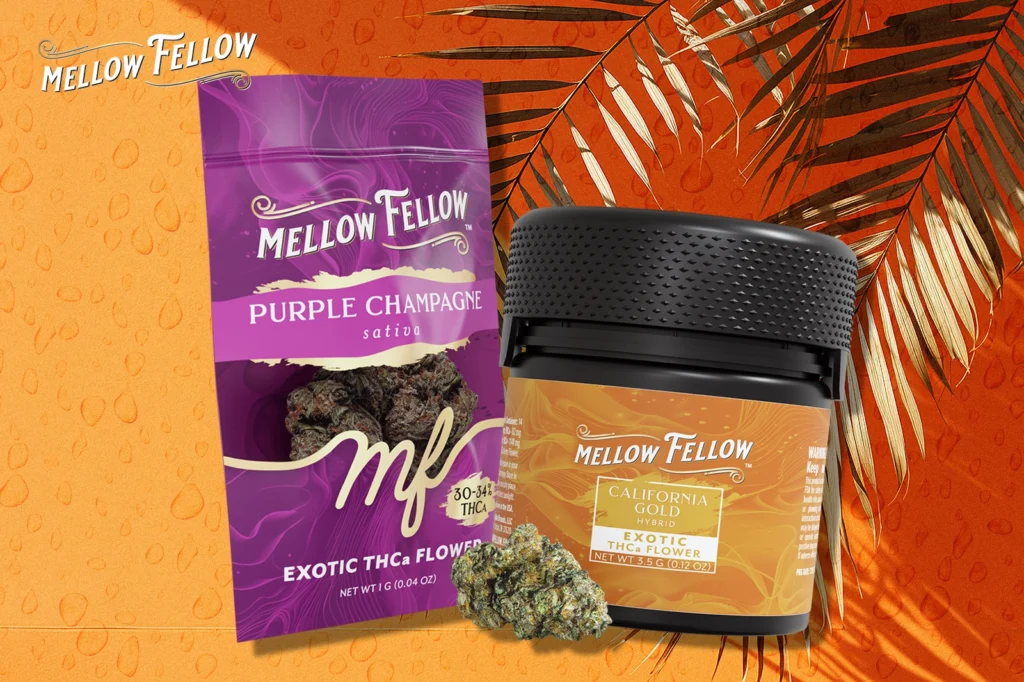
- Mellow Fellow’s THCa Flower Jars use a wide-mouth glass jar built for stable, light-blocking storage all summer long.
How Heat Affects Cannabis Flower and Why It Matters
Heat is the fastest way to age cannabis flower before its time. Cannabinoids and terpenes are chemically reactive compounds, and warmth speeds up the reactions that break them down. The main one to know about is oxidation, where THC slowly converts into cannabinol (CBN), a milder, more sedating cannabinoid. A kinetics study on cannabinoid transformation found that this conversion rate increases substantially as temperature rises, with the sharpest jumps occurring above roughly 50°C (122°F) in concentrated samples, though the same chemistry applies at a slower pace to flower left in a hot car or windowsill for weeks at a time, according to research on cannabinoid degradation kinetics in cannabis resin.
Does Heat Ruin Weed at Normal Summer Temperatures?
So does heat ruin weed at typical summer temperatures, not just lab extremes? A separate kinetic study that tracked whole cannabis flower stored between minus 20°C and 40°C for up to a year found that a network of first-order degradation reactions explains cannabinoid loss even at everyday room temperatures, meaning the process starts well before flower feels obviously “off” to researchers modeling cannabinoid shelf life.
Can weed go bad in the heat, then? Yes, though it rarely turns dangerous. What actually happens is a quieter shift: less potency, a duller high, and a flatter smell. A 2025 analysis of 150 cannabis resin samples stored for up to eight years found that THC content dropped from over 35% in fresh material to under 3% after just two years of storage, with CBN and CBD rising as THC degraded, according to research on long-term cannabinoid transformation in stored cannabis resin. Summer heat does not need years to cause a noticeable dent. It just needs a few weeks of a hot closet or a car dashboard.
Ideal Temperature and Humidity for Storing Cannabis
Cannabis storage temperature and humidity work together, not separately. Getting one right while ignoring the other still leads to dried-out or moldy flower.
| Storage Factor | Ideal Range | What Happens Outside the Range |
| Temperature | 60°F to 70°F | Above 77°F speeds up THC-to-CBN conversion and terpene loss; below 55°F can cause trichomes to become brittle |
| Relative Humidity | 55% to 62% | Above 65% raises mold risk; below 50% dries buds and makes trichomes crumble |
| Light Exposure | Dark or opaque container | Direct sunlight and UV light degrade terpenes within days |
| Air Exposure | Sealed, minimal headspace | Open air accelerates oxidation and dries flower faster |
The ideal temperature for storing cannabis sits well below what most homes hit during a July afternoon, which is exactly why a closet, drawer, or interior cabinet beats a windowsill or countertop near a stove. As for the best humidity for cannabis storage, most cultivators and processors land in the same 55% to 62% window, since it keeps buds pliable and aromatic without creating the damp conditions mold needs to establish.
Best Containers for Storing Weed in Summer
The container matters almost as much as the room it sits in. Plastic baggies let air in, hold static that strips trichomes, and offer no light protection at all.
Airtight containers for cannabis fall into a few reliable categories:
- Glass Jars: Non-reactive, doesn’t hold odors, and pairs well with a tight rubber-seal lid for a true airtight environment.
- Amber or Opaque Glass: Blocks UV light while keeping the airtight seal of clear glass.
- Mylar Bags: Good for bulk amounts and blocks both light and moisture, though less convenient for daily access.
- Vacuum-Sealed Containers: Removes headspace air entirely, useful for flower you plan to store for months rather than days.
Glass jars for cannabis storage remain the most practical daily option because they show you the product, seal tightly, and do not leach flavor the way some plastics can over a hot season. Flower that already ships in a proper glass jar rather than a thin bag has a real head start here, since the correct container is already in hand from the moment the package arrives.
Cannabis Humidity Packs and How to Keep Weed Fresh in Summer
A jar alone gets you part of the way. Humidity packs solve the other half of the equation, which is keeping moisture content stable even as the room around the jar heats up and dries out.
Cannabis humidity packs are small, two-way humidity control packets that release or absorb moisture to hold a jar at a fixed relative humidity, typically 58% to 62%. Here’s how to use a humidity pack for cannabis correctly: drop one pack into the jar alongside the flower, seal the lid, and leave the jar undisturbed for a day so the pack can pull the internal environment to its target humidity. A cannabis storage jar with humidity control built into the lid works the same way but skips the loose packet, which is useful if you open the jar often and don’t want a pack sliding around.
This is also the most direct answer to how to prevent cannabis from drying out during a heat wave. Warm air holds and pulls moisture more aggressively than cool air, so a jar sitting in a hot room without a humidity pack will lose moisture to the surrounding air even with the lid closed, since seals are rarely perfectly airtight over weeks of opening and closing.
Should Weed Be Stored in the Fridge or Freezer
Short answer: no, and this is one of the most common summer mistakes. Should cannabis be stored in a cooler with ice packs for a day trip? That’s a different, more reasonable question, and the answer there is yes for short trips, more on that below.
For everyday storage, refrigerators introduce two problems. First, opening the fridge repeatedly exposes flower to temperature swings that cause condensation on the buds, which raises humidity right into mold territory. Second, the fridge’s ambient humidity is usually far lower than the flower’s ideal range, so buds pulled straight from a jar in the fridge often dry out at the surface while staying slightly damp inside, an uneven result that’s worse than either extreme alone.
Can you freeze cannabis flower? Freezing is even riskier for flower specifically, since the freeze-thaw cycle makes trichomes brittle and prone to snapping off the bud entirely, which is where most of the potency lives. Freezing works better for concentrates and, separately, for edibles; Mellow Fellow’s guide on how to store edible gummies for longevity and potency covers why gummies tolerate cold storage in a way flower does not.
Storing Cannabis in a Hot Car or During a Heat Wave
Storing cannabis in a hot car is one of the fastest ways to damage flower, and the math is worse than most people expect. How long can weed sit in a hot car before it’s noticeably degraded? Faster than a single afternoon errand, in some cases.
Stanford Medicine researchers measured interior vehicle temperatures on sunny days with outside highs between 72°F and 96°F and found that a car’s interior heats up by an average of 40°F within just one hour, with 80% of that temperature rise happening in the first 30 minutes, according to Stanford’s parked car temperature study published in Pediatrics. That means a car reading 75°F outside can hit well over 110°F inside the cabin in under an hour, comfortably inside the range where terpenes evaporate and THC starts converting to CBN.
For storing cannabis during a heat wave, at the beach, or anywhere away from home, a few adjustments help:
- Never Leave Flower In A Parked Car: Even briefly, glove boxes and consoles trap heat faster than the rest of the cabin.
- Use A Smell-Proof, Insulated Pouch: Combines discreet cannabis storage with basic insulation against ambient heat.
- Pack An Ice Pack Separately: Should cannabis be stored in a cooler for a day at the beach? Yes, as long as the flower stays in its sealed jar and never touches the ice directly, which prevents condensation.
- Keep The Container In A Bag, Not A Pocket: Body heat alone is enough to warm a jar noticeably over a few hours outdoors.
Portable cannabis storage for summer and cannabis storage while traveling both come down to the same principle as storage at home: block heat, block light, and keep air out. A compact glass jar in an insulated pouch handles short outings; anything longer than a few hours in real heat calls for the ice-pack approach above.
How Sunlight and UV Light Degrade Cannabis Terpenes
How sunlight affects cannabis is often underestimated compared to heat, but light exposure may actually be the bigger threat to flavor specifically. A peer-reviewed study on terpene stability in cannabis products found that light exposure had the single largest effect on terpene evaporation, with samples exposed to 1200 lux of light for 24 hours losing 99% of their terpene content, while temperature alone caused degradation reaching 92.5% at 50°C, according to research on temperature, humidity, and light exposure in cannabis products.
That is a striking gap. UV light and cannabis degradation move fast enough that a jar left on a sunny windowsill for a single day can lose nearly all of its aromatic complexity, even if the temperature in the room never gets uncomfortably warm. This is the clearest case for protecting cannabis terpenes with opaque or amber glass rather than assuming a clear jar is fine as long as it’s indoors.
How to preserve cannabis potency and how to preserve weed flavor come down to the same short list: dark storage, stable cool temperature, a tight seal, and minimal handling. Every time a jar opens, some terpene content escapes into the room and doesn’t come back. For more on which specific aromatic compounds are most at risk and what they contribute to a strain’s effects, see Mellow Fellow’s complete list of cannabis terpenes and their effects.
Signs Cannabis Has Gone Bad
Knowing the difference between normal aging, heat damage, and mold saves both money and a bad experience.
| Sign | Likely Cause | What To Do |
| Crumbly, dry texture | Low humidity or heat exposure | Add a humidity pack; use within a few weeks |
| Faint or “hay-like” smell | Terpene loss from light or air exposure | Still smokable, but flavor and effect will be muted |
| White, powdery, fuzzy spots | Mold growth from high humidity | Discard the affected flower; do not smoke it |
| Musty, ammonia-like odor | Mold or bacterial growth | Discard immediately |
| Dark, sticky, or overly soft buds | Excess moisture without mold yet | Air out briefly, then store with a tighter humidity range |
Moldy cannabis signs are worth taking seriously beyond just wasted product. Research surveying fungal contamination across the cannabis supply chain has identified Penicillium, Aspergillus, and other mold species capable of establishing on stored flower when humidity runs too high, according to a review of pathogens and molds affecting cannabis production and quality. If flower shows fuzzy white or gray patches, or smells musty rather than earthy, it’s not worth the risk of inhaling.
Dried-out weed, on the other hand, is a texture and flavor problem rather than a safety one. Can heat make cannabis less potent even without visible mold? Yes. THC degradation from heat happens well before flower looks or smells obviously wrong, which is part of why relying on smell or appearance alone underestimates how much potency has actually been lost.
Short-Term vs Long-Term Cannabis Flower Storage
How long does cannabis flower stay fresh depends heavily on which storage approach is used, and short-term habits don’t always scale to long-term storage.
For short-term cannabis storage, meaning anything consumed within a few weeks, a simple airtight glass jar in a cool, dark cabinet is enough. Daily opening and closing is fine as long as the jar stays out of direct sun and away from heat sources like an oven or a sunny counter.
Long-term cannabis flower storage, covering months rather than weeks, benefits from the fuller setup: an opaque or amber glass jar, a humidity pack rated for 58% to 62%, and a location that stays consistently between 60°F and 70°F year-round, not just during cooler months. Buying smaller amounts more frequently is also a practical long-term strategy during summer specifically, since it reduces how long any single batch sits exposed to seasonal heat swings.
This matters slightly more for THCa flower than for already-decarboxylated products, since THCa converts gradually to THC on its own over time even before heat or light get involved, and warm storage speeds that natural conversion up. Single-serving formats sidestep the long-term storage question almost entirely, since there’s no leftover product exposed to a full summer of heat between uses.
Mellow Fellow Products Built for Summer Storage
Choosing the right format upfront makes summer storage far less of a daily chore. Mellow Fellow’s flower lineup includes two options built around exactly this problem.
The THCa Exotic Flower Jars collection ships premium exotic strains, from Sativas to Indicas and Hybrids, in a proper glass jar rather than a bag, giving buyers a stable, airtight container from the moment it arrives. That means one less step between unboxing and correct storage, and a container solid enough to reuse with a humidity pack for the rest of the batch’s shelf life.
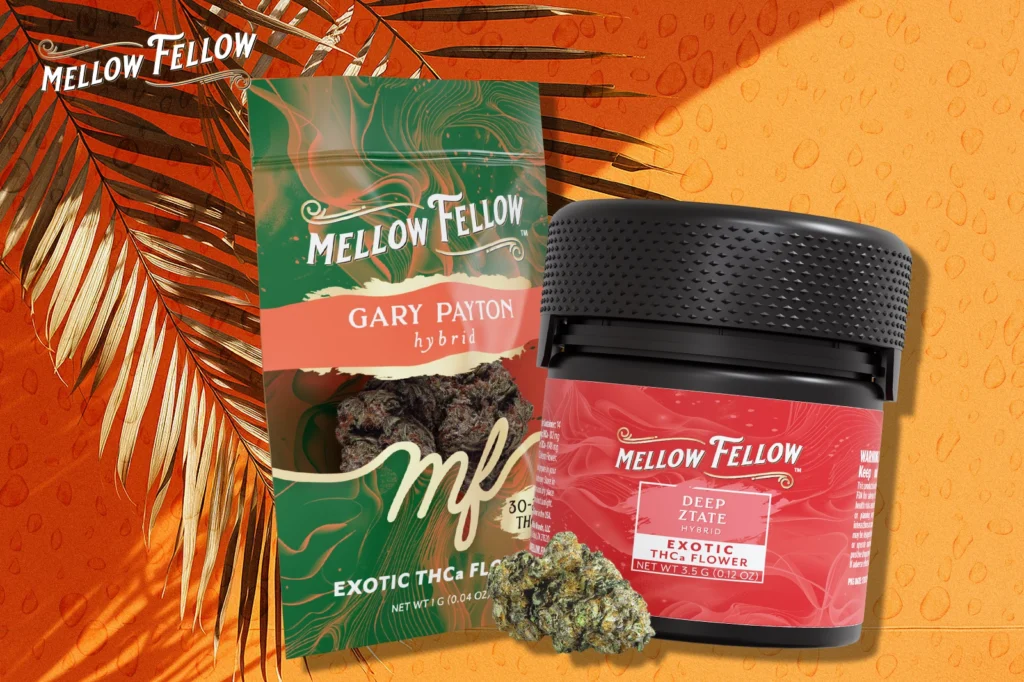
For anyone who wants to skip the storage question entirely, the Exotic THCa Flower 1g Sachets line portions high-strength, terpene-rich flower into single-gram servings. Since each sachet is meant to be used shortly after opening, there’s no leftover flower sitting exposed to heat, light, or fluctuating humidity for weeks at a time, which sidesteps the entire storage problem for anyone who doesn’t want to manage jars and humidity packs during a busy summer.
Vape cartridge users deal with a related but different heat problem, since cannabis oil rather than dried flower is what’s at risk. For anyone splitting time between flower and carts this summer, Mellow Fellow’s guide on why weed carts expire and the companion piece on why a cart looks foggy cover the oil-specific version of the same heat and light problem discussed here.
Conclusion
Summer heat, sunlight, and humidity swings all work against cannabis flower in different ways, but the fix is the same short list every time: an airtight, opaque container, a stable temperature between 60°F and 70°F, humidity held around 55% to 62%, and a dark storage spot away from cars, windowsills, and hot countertops. Get those four factors right and a batch of flower will taste, smell, and hit the same in August as it did the day it arrived.
Ready to start with flower that’s already stored the right way? Browse Mellow Fellow’s THCa Exotic Flower Jars for premium strains in proper glass storage, or grab the Exotic THCa Flower 1g Sachets if single-serving convenience fits your summer better.
Frequently Asked Questions
What Temperature Is Too Hot For Weed?
Cannabis flower begins losing potency and flavor once temperatures climb above roughly 77°F for extended periods, with degradation accelerating further past 85°F to 90°F. A parked car in direct sun can exceed both of these thresholds within an hour, even on a mild day.
Does Humidity Affect Cannabis Potency?
Yes, indirectly. Humidity itself doesn’t destroy cannabinoids the way heat does, but humidity above 65% creates conditions for mold, which ruins the batch entirely, while humidity below 50% dries out trichomes and causes potency-rich material to crumble away from the bud.
Should Cannabis Be Kept In The Dark?
Yes. Light, particularly UV light, is one of the fastest ways to strip terpenes from cannabis flower, with some research showing near-total terpene loss after just 24 hours of light exposure. An opaque container or a dark cabinet protects flavor and aroma far better than a clear jar on an open shelf.
What Is The Best Place To Store Weed At Home?
An interior closet, dresser drawer, or cabinet away from exterior walls, windows, appliances, and direct sunlight works best. These spots stay closer to a stable 60°F to 70°F range year-round compared to countertops, garages, or rooms with direct afternoon sun.
How Long Can Weed Sit In A Hot Car Before It’s Damaged?
Noticeable heat damage can begin within an hour. Vehicle interiors can climb roughly 40°F above the outside temperature in that time, according to Stanford research, putting flower well past the point where terpenes and cannabinoids start breaking down.
Can You Freeze Cannabis Flower To Make It Last Longer?
Freezing isn’t recommended for flower specifically. The freeze-thaw cycle makes trichomes brittle and prone to breaking off the bud, which removes potency along with them. Freezing works better for concentrates and edibles than for dried flower.
How Do I Know If My Cannabis Has Gone Bad From Heat Or Mold?
Heat damage typically shows up as dry, crumbly texture and a faded, hay-like smell rather than the strain’s original aroma. Mold looks different: white, gray, or fuzzy spots, or a musty, ammonia-like smell. Heat-damaged flower is still safe to use, though weaker; moldy flower should be discarded.
How Long Does Cannabis Flower Stay Fresh In Summer?
With proper airtight, dark, cool storage, flower can stay close to its original potency and flavor for several months. Without those precautions, and especially with heat or light exposure, noticeable degradation in flavor and potency can begin within just a few weeks.
Discreet Cannabis Storage: What Options Work Best For Travel?
Smell-proof, opaque pouches or cases designed specifically for cannabis storage combine odor control with light protection, making them a practical choice for travel or day trips. Pairing one with a sealed glass jar inside gives both discretion and the airtight, dark environment flower needs.
Should Cannabis Be Stored In A Cooler For Beach Trips?
For short outings in extreme heat, yes, as long as the flower stays in its sealed container and doesn’t make direct contact with ice, which can introduce condensation and raise humidity inside the jar. For anything longer than a day, standard cool, dark storage at home remains the better option.
Sources
- Kinetics of CBD, Δ9-THC Degradation and Cannabinol Formation in Cannabis Resin at Various Temperature and pH Conditions (2021) https://www.liebertpub.com/doi/10.1089/can.2021.0004
- Thermal Stability of Cannabinoids in Dried Cannabis: A Kinetic Study (2021) https://link.springer.com/article/10.1007/s00216-020-03098-2
- The Role of Time and Storage Conditions on the Composition of Hashish and Marijuana Samples: A Four-Year Study (2019) https://www.sciencedirect.com/science/article/abs/pii/S0379073818308818
- Surroundings Impact on Terpene Stability in Terpene-Infused Pre-Rolled Cones: The Role of Temperature, Humidity, and Light Exposure (2024) https://jffhmt.avestia.com/2024/043.html
- Parked Cars Get Dangerously Hot, Even on Cool Days, Stanford Study Finds (2005) https://med.stanford.edu/news/all-news/2005/07/parked-cars-get-dangerously-hot-even-on-cool-days-stanford-study-finds.html
- Pathogens and Molds Affecting Production and Quality of Cannabis sativa L (2019) https://pubmed.ncbi.nlm.nih.gov/31681341/