
THC vs THCv as a Pre-Workout: Which One Should You Use?
Quick Answer: THC and THCv both come from the cannabis plant, but they behave very differently before a workout. THC is more likely to slow reaction time and impair balance, making it a poor fit for training sessions that demand coordination. THCv, by contrast, is non-intoxicating at low to moderate doses and is associated with clear-headed energy and focus, which is why newer pre-workout formulations lean on it instead of classic THC.
“THC pre-workout” has been a search term for years, usually tied to the idea that a little euphoria might make a hard set feel easier. The research tells a more complicated story, and it is why the cannabinoid conversation around exercise has started shifting toward THCv, a lesser-known relative of THC with a very different effect profile.
Mellow Fellow’s own lineup reflects that shift: alongside classic THC formats, several current blends now build around THCv specifically for daytime, activity-focused use, with additional THCv-forward formats in development. This guide breaks down what separates THC from THCv before a workout, what the actual research supports, and how to choose between them.
Key Takeaways
- THC reduced arm and leg movement speed by up to 16% in frequent users tested shortly after use
- A controlled cycling study found 10mg of edible THC was neither ergogenic nor ergolytic, meaning it did not measurably help or hurt performance
- THCv acts as a CB1 receptor antagonist at low doses and a partial agonist at higher doses, the opposite dose pattern of THC
- WADA prohibits THC and most other cannabinoids in-competition, with a 150 ng/mL urinary threshold that applies only to THC
- Mellow Fellow’s Charged and Clarity blends build around THCv specifically for daytime, activity-focused use
What Makes a Cannabinoid Effective as a Pre-Workout
Before comparing THC and THCv directly, it helps to define the bar a cannabinoid needs to clear to earn the “pre-workout” label. A genuinely useful pre-workout compound should support alertness and focus, avoid impairing coordination or reaction time, and not carry a heavy sedation or anxiety risk at working doses.
For context on what a well-established pre-workout ingredient actually delivers, the International Society of Sports Nutrition’s position stand on caffeine reports that caffeine at 3 to 6mg per kilogram of body mass reliably improves endurance performance by 2 to 4% and muscular strength by 2 to 7% across dozens of controlled trials. That is the kind of consistent, dose-dependent evidence base cannabinoids are still working to build. Judged against that standard, neither THC nor THCv is a proven ergogenic aid in the way caffeine is, but they solve different problems for different training styles.
THC as a Pre-Workout: What the Research Shows
THC (Delta-9-tetrahydrocannabinol) is the cannabinoid most people think of first, and the research on it before exercise is more nuanced than either side of the debate usually admits.
THC and Motor Coordination
A 2021 study published in Frontiers in Psychiatry measured motor performance in 65 frequent cannabis concentrate users before and after use. Arm movement speed slowed by 15% immediately after use and remained 16% slower an hour later. Balance also worsened immediately after use, both with eyes open and closed. These are not the effects most people want walking into a lifting session or a technical movement pattern.
THC’s Effect on Endurance Performance
The picture is less one-sided for lower, edible doses. A 2022 study in Frontiers in Physiology gave habitual cannabis users 10mg of edible THC before a 20-minute cycling time trial and a maximal sprint test. THC did not change mean power output, peak power, or time to fatigue compared to placebo. The researchers concluded that 10mg of THC was neither ergogenic nor ergolytic, meaning it neither helped nor hurt performance in this setting. That is a more measured finding than either “THC ruins your workout” or “THC boosts your workout” claims typically suggest.
The honest takeaway is that THC’s effect on a workout depends heavily on dose, format, and the specific task. Coordination-heavy activity carries real risk. Steady-state cardio at a controlled, familiar dose showed no measurable downside in that one study, though it also showed no upside.
THCv as a Pre-Workout: The Newer Alternative
THCv (tetrahydrocannabivarin) is structurally similar to THC but behaves almost oppositely at the receptor level, which is exactly why it has become the cannabinoid of choice in newer pre-workout style formulations. For a full breakdown of the molecular differences, see our guide on THCv vs THC differences.
THCv’s Dose-Dependent Receptor Activity
A 2025 study published in Biomolecules tested THCv in rats trained to discriminate THC from a vehicle. THCv produced an inverted U-shaped substitution curve: at a moderate dose it partially substituted for THC and increased response rate, described by the researchers as a stimulant-like effect, while at a higher dose it reversed THC’s effects instead. The study’s authors describe THCv as acting as a CB1 receptor antagonist at lower doses and a partial agonist at higher ones, the functional opposite of how THC behaves at the same receptor. That dual profile is part of why THCv reads as clear-headed and energizing rather than sedating for most users. Our what is THCv guide covers this mechanism in more depth.
THCv and Metabolic Energy
THCv’s reputation for supporting energy is not purely anecdotal. A 2013 study in Nutrition & Diabetes found that THCv increased 24-hour energy expenditure by 7 to 17% in mouse models, depending on dose, without producing the appetite suppression or weight loss sometimes claimed in marketing copy. It is worth being precise here: this study measured energy expenditure and metabolic markers, not exercise performance directly, and it was conducted in mice. Still, the mechanism lines up with why THCv-forward blends are positioned for daytime activity rather than sedentary use.
THC vs THCv for Pre-Workout: A Side-by-Side Comparison
| Factor | THC | THCv |
| Typical Effect | Euphoria, relaxation, potential coordination impairment | Clear-headed alertness, non-intoxicating at low-moderate doses |
| Receptor Behavior | CB1 agonist | CB1 antagonist (low dose), partial agonist (high dose) |
| Best Suited For | Lower-intensity, non-technical activity, or post-workout wind-down | Warm-ups, focus-driven training, daytime sessions |
| Competition Legality | Prohibited in-competition by WADA above a 150 ng/mL threshold | Prohibited in-competition in any detectable amount |
| Evidence Base | Mixed: coordination risk documented, endurance effect in one study was neutral | Early and mostly preclinical, but mechanistically distinct from THC |
How THCv Interacts With THC in the Body
Several Mellow Fellow blends intentionally pair THCv with small amounts of THC-family cannabinoids rather than isolating either compound. The receptor research helps explain why that combination can work. Because THCv can act as a partial CB1 antagonist at lower doses, it may take the edge off THC’s more intoxicating effects while contributing its own alerting quality. This is a different strategy from products built purely around Delta 9 or Delta 8 THC, where the goal is a fuller psychoactive experience rather than a balanced, activity-friendly one.
For readers deciding between formats, our post on motivation and exercise covers how cannabinoid blends interact with dopamine and cortisol pathways relevant to workout motivation, and our does CBG give you energy guide covers CBG’s related but distinct role in focus-oriented blends.
Mellow Fellow Products for THC and THCv Pre-Workout Use
Mellow Fellow’s current lineup spans both classic THC formats and newer THCv-forward blends, alongside a THCv Burn softgel line built specifically around rapid-release THCv that is expected to expand the pre-workout category further as it rolls out.
For a THCv-forward vape built for daytime energy, the Charged Blend Terp Sauce 5ml Disposable Vape (Sunset Octane, Sativa) combines H4CBD, CBG, and THCv in a profile the product description calls “high-octane productivity” before easing into calm, a pattern well suited to a warm-up before training.
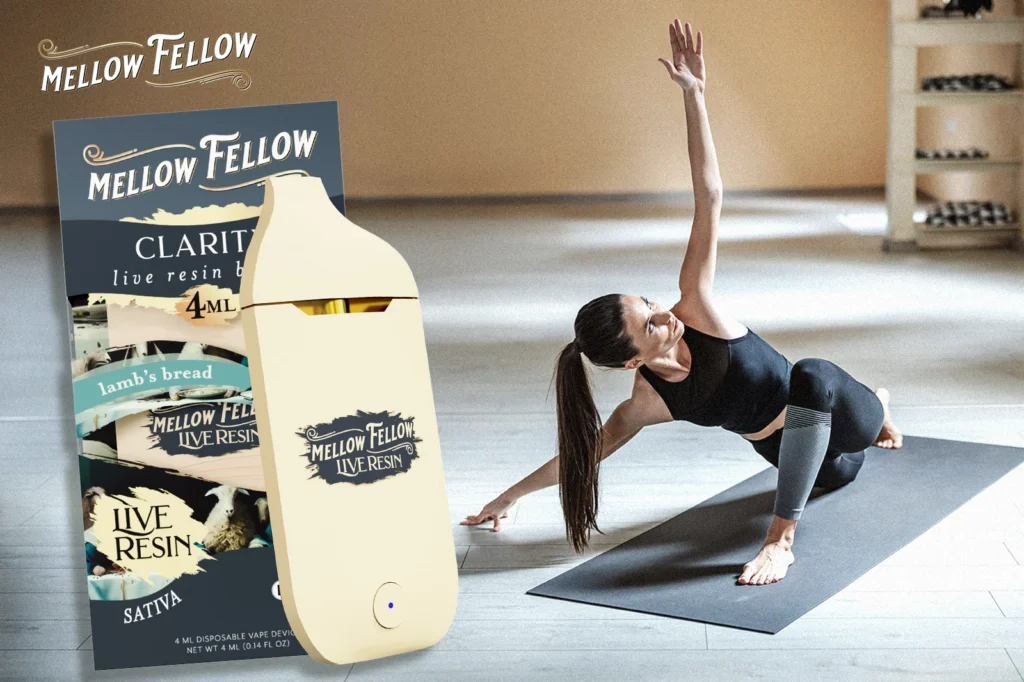
The Clarity Blend 4ml Live Resin Disposable Vape (Lamb’s Bread, Sativa) pairs Delta 8, CBD, CBG, and THCv for what the brand describes as a clear-headed and focused vaping experience, a useful option for technical lifts or skill work where coordination matters.
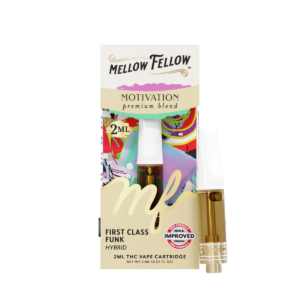
For a CBG-forward option without THCv, the Motivation Blend 2ml Vape Cartridge (First Class Funk, Hybrid) uses H4CBD and CBG for a stimulating, creativity-and-productivity-oriented effect that some users prefer for morning training sessions.
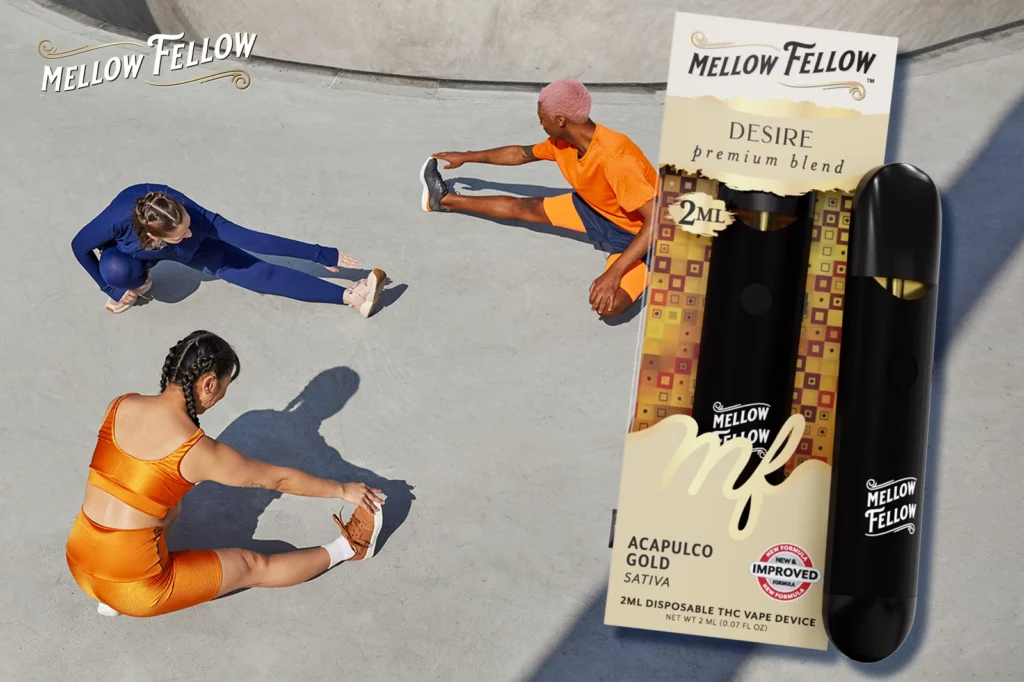
If a fuller, more classic THC experience fits your training style better, the Desire Blend 2ml Disposable Vape (Acapulco Gold, Sativa) blends THCh, Delta 11, Delta 8, CBD, and CBG for an energetic body high paired with cerebral effects, better suited to lower-intensity movement than technical training.
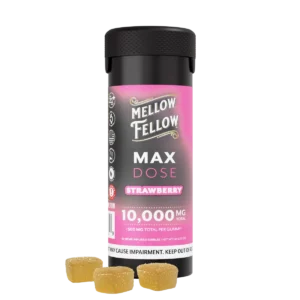
For post-workout or rest-day use where sustained THC effects are the goal rather than pre-training energy, the Max Dose Gummies (20ct, 10,000mg, Strawberry) deliver 500mg of combined Delta 8 and Delta 9 THC per gummy, a format built for relaxation rather than pre-training alertness. Our guide to CBD for recovery covers non-intoxicating options for that same post-training window.
All Mellow Fellow products are lab tested, with results available on our testing page.
THC, THCv, and Competitive Sports: What Athletes Need to Know
Anyone training for a tested sport needs to know the rules before reaching for either cannabinoid.
A few facts worth knowing before competition:
- THC Threshold: WADA sets a 150 ng/mL urinary threshold for THC specifically, meaning trace amounts below that level in-competition will not trigger a positive test
- Other Cannabinoids: According to USADA’s Marijuana FAQ, all other cannabinoids besides CBD, including natural compounds like THCv, are prohibited in-competition in any detectable amount, with no threshold
- In-Competition Window: The prohibition applies only during competition periods, not during out-of-competition training
- CBD Exception: CBD alone was removed from the prohibited list in 2019, though products can carry cross-contamination risk
This means THCv is not automatically a “safe” competition option just because it is non-intoxicating. Athletes in tested sports should treat any cannabinoid product as a competition-day risk and plan use accordingly.
Choosing the Right Pre-Workout Cannabinoid for Your Training Style
Different training goals call for different cannabinoid profiles. A few starting points:
- Technical Lifts or Skill Work: THCv-forward blends, since coordination and focus matter more than intensity
- Steady-State Cardio: Either option in moderation, based on the Frontiers in Physiology finding of no measurable effect either way at low THC doses
- Morning Training Sessions: CBG or THCv blends for clear-headed alertness without a heavy psychoactive load
- Post-Workout Wind-Down: Classic THC or CBD-forward products, since sedation is a feature rather than a drawback at that point in the day
THC vs THCv Dosing and Timing Guide
| Cannabinoid | Typical Onset (Vape) | Typical Onset (Edible) | Pre-Workout Timing |
| THC | 5-10 minutes | 45-90 minutes | 15-30 minutes before low-intensity activity only |
| THCv | 5-15 minutes | 45-90 minutes | 20-30 minutes before training for alertness effects |
These windows reflect general onset patterns rather than fixed rules, since individual metabolism, tolerance, and product formulation all shift the timing.
Conclusion: Matching the Cannabinoid to the Training Session
THC and THCv are not competing versions of the same idea. THC carries a real, documented coordination risk that makes it a poor match for most structured training, even though one controlled study found no measurable harm to cycling performance at a modest edible dose. THCv sits at the other end of the spectrum: non-intoxicating at typical doses, mechanistically built for alertness rather than sedation, and increasingly the cannabinoid of choice in blends designed for daytime activity.
Neither is a proven performance enhancer in the way a well-studied ingredient like caffeine is, and both come with real considerations for anyone in a tested sport. The honest approach is to match the cannabinoid, and the format, to what a specific session actually calls for. Ready to find the right fit for your training day? Browse the THC and THCv options above, from the THCv-forward Charged and Clarity blends to the classic THC lineup, and start with the smallest effective amount.
Frequently Asked Questions
Is THC A Good Pre-Workout?
Not for most structured or technical training. Research shows THC can slow arm and leg movement speed and impair balance shortly after use. One study found a modest 10mg edible dose had no measurable effect, positive or negative, on cycling performance, so low-intensity, non-technical activity carries less documented risk than skill-based or heavy lifting sessions.
Is THCv Better Than THC For Working Out?
THCv is better suited to most pre-workout goals because it is non-intoxicating at low to moderate doses and is associated with clear-headed alertness rather than the coordination risks linked to THC. THCv is not a proven performance enhancer, but its effect profile aligns more closely with what people generally want before training.
Does THCv Actually Give You Energy?
Research in mouse models found THCv increased 24-hour energy expenditure at several tested doses. That is a metabolic finding, not a direct measurement of gym performance, but it lines up with the alert, non-sedating experience most users report.
Will THC Or THCv Show Up On A Drug Test?
Both can potentially trigger a positive result on standard drug tests, since THCv shares structural similarity with THC. If a drug test is upcoming, avoid all THC-family cannabinoids, including THCv, until testing is complete.
Can Athletes In Tested Sports Use THCv Before A Workout?
Only outside of competition windows. WADA prohibits THCv and most other cannabinoids in-competition in any detectable amount, with no threshold exception the way THC has. Training-day use outside competition periods falls under different rules, but athletes should confirm their specific sport’s policy.
Can You Combine THC And THCv In The Same Product?
Yes, and several Mellow Fellow blends do exactly that. Because THCv can act as a partial antagonist to THC’s effects at lower doses, combining the two may soften THC’s more intoxicating qualities while adding THCv’s alerting characteristics.
What Is The Best THCv Product For Pre-Workout Use?
It depends on the training type. Vape formats like the Charged Blend or Clarity Blend deliver THCv quickly for same-session use, while edible formats provide a longer, more gradual build appropriate for planning further ahead of a workout.
Sources
- International Society of Sports Nutrition Position Stand: Caffeine and Exercise Performance
- Acute Effects of Cannabis Concentrate on Motor Control and Speed: Smartphone-Based Mobile Assessment
- Edible Marijuana and Cycle Ergometer Exercise
- Tetrahydrocannabivarin (THCV) Dose Dependently Blocks or Substitutes for Tetrahydrocannabinol (THC) in a Drug Discrimination Task in Rats
- The Cannabinoid Δ9-Tetrahydrocannabivarin (THCV) Ameliorates Insulin Sensitivity in Two Mouse Models of Obesity
- Marijuana FAQ