Can Bars Sell THC Drinks? Laws, Licensing, and the State of Cannabis Beverages
Quick Answer: Yes, bars can legally sell THC drinks in many U.S. states, but only under specific conditions. Hemp-derived Delta 9 THC beverages with less than 0.3% THC by dry weight are federally legal under the 2018 Farm Bill, meaning on-premise sales are possible in states that permit them – though licensing, labeling, and compliance requirements vary significantly by location.
The U.S. hospitality industry is in the middle of a quiet but significant shift. Across dozens of states, bars, restaurants, and event venues are adding THC-infused drinks to their menus – not as a legal gray-area experiment, but as a legitimate product category backed by federal hemp law. For operators and consumers alike, the question is no longer just “are THC drinks legal?” It’s “how does this actually work at the bar level?”
This guide covers THC drink regulations by state, what licensing bars may need, how hemp THC beverages differ from marijuana drinks, and what the growing THC beverage market means for hospitality businesses. It also covers the practical realities of serving THC-infused drinks alongside alcohol, and what responsible service looks like when both are on the menu.
Key Article Takeaways
- Hemp-derived Delta 9 THC drinks containing less than 0.3% THC by dry weight are federally legal under the 2018 Farm Bill
- State law governs on-premise THC beverage sales, and rules differ widely – some states permit bar sales outright, others ban them entirely
- Bars typically do not need a cannabis license to sell hemp THC drinks, but may need a hemp retailer permit depending on state rules
- Low-dose THC drinks (2-10 mg per serving) have become the standard format for hospitality settings, reducing overconsumption risk
- Nano-emulsified THC beverages can onset in 15-30 minutes, making them more practical for bar settings than traditional edibles
- Minnesota’s THC beverage market – the most developed on-premise model in the country – is valued at nearly $200 million with roughly 4,000 registered retailers
- Mellow Fellow offers ready-to-drink THC seltzers and mixers designed for social consumption at consistent, manageable doses
Federal Law and Hemp THC Drinks: The Starting Point
The 2018 Farm Bill created the legal framework that makes hemp-derived THC beverages possible. Under federal law, hemp is defined as cannabis containing no more than 0.3% Delta 9 THC by dry weight. Products derived from compliant hemp – including Delta 9 THC drinks – are not classified as controlled substances at the federal level.
This matters for bars and restaurants because it means hemp THC beverages can, in principle, be ordered from licensed hemp distributors and sold like any other non-alcoholic specialty product. The USDA’s Domestic Hemp Production Program confirms that hemp-derived products meeting this threshold are treated as agricultural commodities, not controlled substances, once they leave the farm and enter commerce.
What the federal framework does not do is override state law. The FDA concluded in January 2023 that existing regulatory frameworks for foods and supplements are not appropriate for cannabidiol and has called on Congress to create a new pathway. This regulatory gap is what each state fills differently. For anyone considering adding THC drinks to a bar menu, state law is the real determining factor.
For a broader look at how THC drinks work and what is in them, see THC Drinks: Everything You Need to Know About Cannabis Beverages.
Can Bars Legally Sell THC Drinks? A State-by-State Reality
There is no single national answer to whether bars can sell THC-infused drinks. The legal status depends entirely on where the business operates. Here is how the landscape breaks down.
States Where On-Premise THC Beverage Sales Are Permitted
Minnesota has the most developed on-premise framework in the country. The state passed legislation explicitly allowing hemp-derived THC beverages to be sold for on-site consumption in licensed establishments, including bars and restaurants.
According to an analysis published in the Cannabis Law Journal, this regulatory framework allows consumers to drink THC beverages in social settings similarly to alcoholic beverages, and Minnesota’s THC beverage market is now worth nearly $200 million with roughly 4,000 registered retailers. Effective July 1, 2024, licensed businesses can even offer THC beverages on tap.
Texas, despite restrictive cannabis policy overall, has seen hemp THC drinks sold in bars and retail locations under its hemp program, where no explicit on-premise ban exists. In states with permissive hemp retail frameworks and no conflicting alcohol authority rules, bars can generally stock and serve hemp THC drinks.
States With Restrictions or Outright Bans
Some states have moved to restrict or ban psychoactive hemp products entirely, including beverages. Idaho maintains a near-total ban on any THC-containing product. Florida’s regulatory regime for hemp-derived products does not contemplate on-premises consumption – businesses can sell pre-packaged hemp products as a “Hemp Food Establishment,” but that permit does not extend to on-site consumption. Georgia’s recently-signed hemp law similarly limits THC beverages to prepackaged retail sales rather than on-premise service.
The Alcohol Authority Problem
One of the most common friction points for bars is that state alcohol regulators – the entities that issue liquor licenses – may have jurisdiction over what a licensed alcohol establishment can sell. In some states, a liquor license holder is prohibited from selling any psychoactive product not expressly permitted by the alcohol authority, even if that product is federally legal hemp. Operators should confirm with their state’s alcohol beverage control board before adding THC drinks to their menu.
Minnesota itself ran into this issue after its initial legislation included a “five-hour rule” prohibiting servers from selling THC drinks to anyone who had consumed alcohol within the previous five hours. As documented in a Minnesota Law Review analysis, the rule created significant compliance uncertainty and led many bars to stop selling THC beverages entirely to avoid liability – a cautionary example of how well-intentioned rules can undercut a market.
The table below outlines the general compliance landscape.
|
State Category |
THC Drink Status |
Notes |
|
Permissive hemp states (e.g., Minnesota, Texas) |
Generally allowed |
Age verification and labeling requirements apply |
|
Cannabis-legal states (adult use) |
Usually requires cannabis retail license |
Hemp THC drinks may fall under separate rules |
|
Restrictive hemp states (e.g., Idaho) |
Limited or banned |
Check current state hemp program rules |
|
Alcohol authority overlap states |
Conditional |
Liquor board approval may be required |
THC Beverage Licensing: What Bars Actually Need
Most bars do not need a cannabis license to sell hemp-derived THC drinks. Because these products are classified as hemp under federal law, they are not subject to cannabis retail licensing frameworks in most states. That said, specific permits or registrations may still apply.
Hemp Retailer Registration: Some states require any business selling hemp-derived consumable products to register with the state department of agriculture or a designated hemp regulatory body.
Age Verification Compliance: THC drink sales are universally restricted to adults 21 and older. Bars already have age verification systems in place, but staff training specific to THC product sales may be required under state rules.
Labeling and COA Requirements: States with active hemp programs typically require that products on the shelf carry a Certificate of Analysis (COA) from a third-party lab, confirming cannabinoid content and the absence of contaminants. Mellow Fellow posts third-party lab results for all products, making compliance documentation straightforward for retail partners.
Alcohol License Conditions: Bars holding a liquor license should review their license conditions carefully. Some licenses prohibit the co-sale of psychoactive products not expressly covered, while others are silent on the matter. In ambiguous cases, a letter of inquiry to the state alcohol authority is advisable.
For operators interested in stocking Mellow Fellow’s THC beverages, the wholesale program provides a direct path for commercial buyers.
Hemp THC Drinks vs. Marijuana Drinks: Why the Distinction Matters for Bars
The difference between hemp-derived THC drinks and marijuana-derived cannabis beverages is more than semantic. It determines whether a product can legally enter most bar supply chains.
Hemp THC Drinks: Derived from federally legal hemp. Delta 9 THC content is below 0.3% by dry weight. Can be distributed through standard wholesale channels in states with permissive hemp frameworks. No cannabis license required for retail in most states.
Marijuana-Derived Cannabis Beverages: Derived from cannabis plants that exceed the 0.3% THC threshold. Classified as a controlled substance under federal law. Sales restricted to licensed cannabis retailers in adult-use states. Cannot cross state lines.
For bars in states without a cannabis retail market, hemp-derived THC drinks are the only legal pathway to offer cannabis-infused beverages. Even in adult-use states, hemp THC drinks offer a simpler compliance path for operators not set up as cannabis retailers.
The practical effect for consumers is often similar. A 5 mg or 10 mg Delta 9 THC drink made from hemp delivers the same compound as a marijuana-derived beverage at the same dose. The difference is in the supply chain, not the experience.
How THC Drinks Work: Onset, Duration, and Dosing for Bar Settings
One of the early concerns about THC drinks in hospitality settings was unpredictable onset. Traditional cannabis edibles can take 45-90 minutes to hit, which creates real overconsumption risk when someone assumes a drink is not working and orders another.
Modern THC beverages have largely addressed this through nano-emulsification. This process breaks cannabinoid molecules into ultra-small, water-compatible droplets that absorb more quickly through the mucosal lining and gastrointestinal tract.
A 2025 crossover study published in the Journal of Cannabis Research found that self-nanoemulsifying cannabinoid formulations produced significantly shorter time-to-maximum-concentration (Tmax) compared to standard oil-based drops – with 11-OH-THC Tmax averaging 0.86 hours versus 4.54 hours for the conventional format. The nano formulation also more than doubled the relative bioavailability.
An earlier review published in Cannabis and Cannabinoid Research confirmed that lipid-based emulsions and nano-encapsulation consistently improve cannabinoid absorption rates compared to unformulated oil preparations, supporting faster and more predictable onset across edible and beverage formats.
In practical bar terms, nano THC beverages typically onset in 15-30 minutes – much closer to a beer or cocktail than a gummy. This makes them significantly more appropriate for on-premise service, where guests expect to feel something within a reasonable window.
Standard Dosing Tiers for Hospitality:
- Microdose (2-5 mg): Suitable for cannabis-naive guests; mild relaxation with minimal psychoactive effect
- Low Dose (5-10 mg): The most common format for ready-to-drink THC beverages; produces noticeable but manageable effects for most adults
- Moderate Dose (10-20 mg): Better suited for experienced consumers; may be too strong for first-time or low-tolerance guests
For a head-to-head look at how Mellow Fellow’s THC drinks compare to competitor brands, see Uncle Arnie’s vs. High Rise vs. Mellow Fellow THC Drinks and Brez vs. Wynk vs. Mellow Fellow.
Mellow Fellow THC Beverages: Products Built for Social Settings
Mellow Fellow’s THC drink lineup covers two formats: ready-to-drink seltzers and concentrated mixers. Both are formulated with hemp-derived Delta 9 THC and additional cannabinoids for a balanced, social experience.
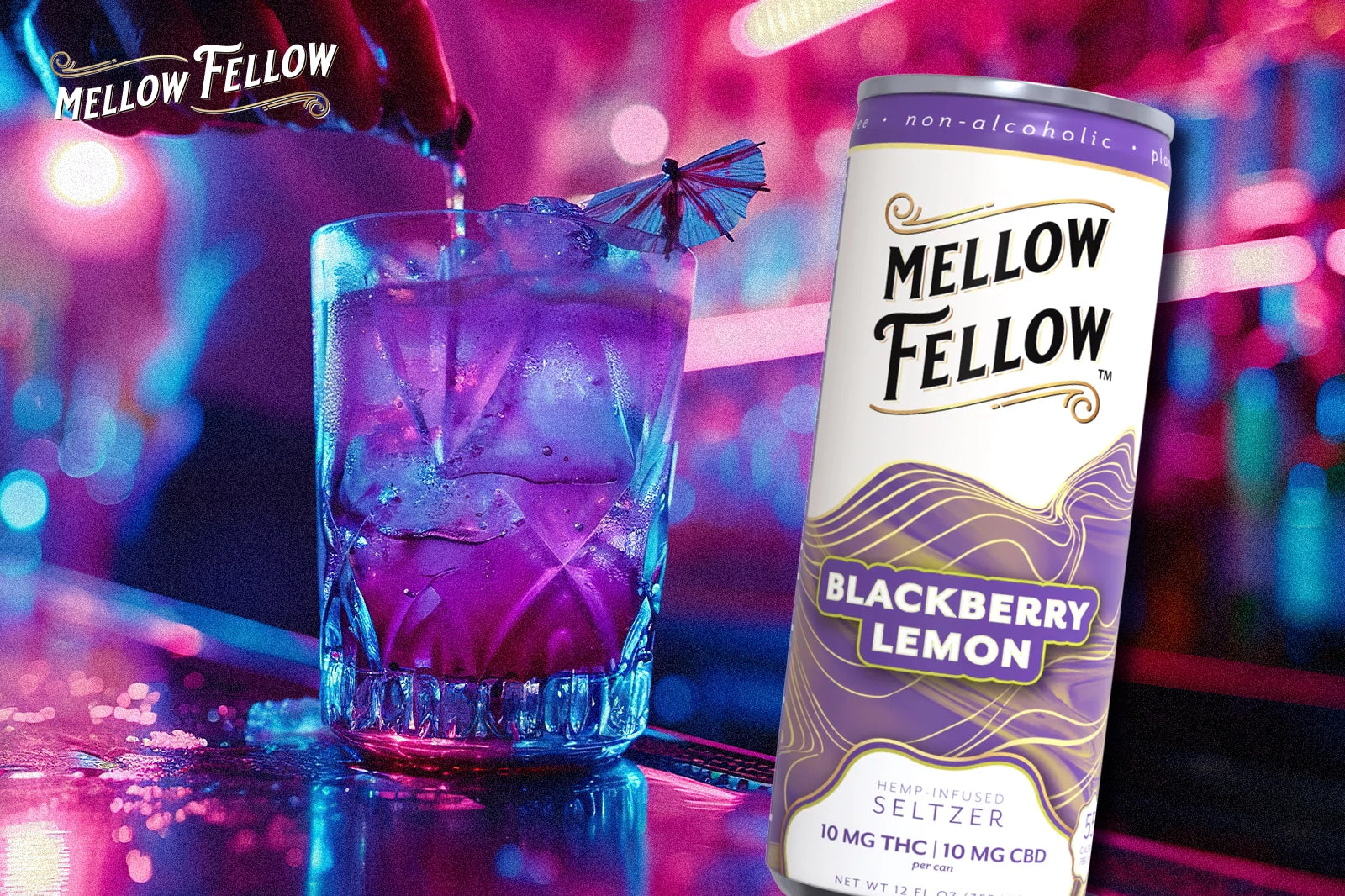
THC + CBD Seltzers (20 mg Delta 9 THC + CBD)
These ready-to-drink seltzers are carbonated, lightly flavored, and dosed at 20 mg Delta 9 THC per can – a clear, single-serving format that works well in a bar context because it requires no preparation and leaves no ambiguity about dosing.
Browse the full Delta 9 THC Seltzer collection for current availability.
Delta 9 + CBD + CBG Mixers
The mixer format is designed for cocktail programs and mixed-drink applications. Each mixer contains Delta 9 THC, CBD, and CBG – a cannabinoid combination that many users find produces a cleaner, more social effect than THC alone. CBG and CBD do not produce intoxicating effects on their own, but they interact with the endocannabinoid system alongside Delta 9 in ways that users commonly describe as more balanced and less anxious.
The mixer format opens a straightforward path to THC mocktail programs. A bar can build a dedicated non-alcoholic THC cocktail menu using these as the base – pre-flavored, pre-dosed, and simple to serve without alcohol. Browse the complete THC mixer and beverage collection or see all Mellow Fellow drinks.
For a closer look at how these cannabinoids work together, see Can You Mix CBD and THC?.
The Business Case for Adding THC Drinks to a Bar Menu
The THC beverage market is expanding fast. According to data from Grand View Research, the global cannabis beverages market is expected to reach $3.86 billion by 2030, growing at a CAGR of 19.2% from 2024 to 2030. Tracking data from BDSA showed that cannabis beverage sales posted a 15% increase between Q1 2024 and Q1 2025, with emerging markets like Michigan growing by more than 100% year-over-year.
For hospitality operators, several practical reasons support adding THC drinks alongside or instead of certain alcohol offerings.
Margin and Differentiation: THC drinks are a premium product in a largely undifferentiated bar market. They give operators a menu item that generates conversation, distinguishes the establishment, and typically carries a healthy margin relative to cost.
Serving Sober and Sober-Curious Guests: U.S. drinking rates have dropped to historic lows. According to Gallup’s 2024 Consumption Habits survey, 45% of Americans now say drinking in moderation is bad for their health – a six-point increase from 2023 and the highest reading since Gallup began tracking. A 2025 Gallup survey found the share of Americans who drink alcohol fell to a record low of 54%. THC drinks give sober-curious guests a social-drinking alternative that still delivers a distinct effect.
A Different Risk Profile Than Alcohol: Bars that serve intoxicating beverages carry liability exposure for intoxicated patrons. Low-dose THC drinks have a different risk profile than alcohol at typical serving quantities, including no caloric contribution from ethanol and no hangover effect. Many operators view them as a practical complement to their current beverage program when served responsibly.
The table below compares key characteristics of alcohol versus low-dose THC drinks in a bar context.
|
Factor |
Alcohol |
Low-Dose THC Drink (5-10 mg) |
|
Onset time |
15-30 min |
15-30 min (nano-emulsified) |
|
Duration |
1-3 hours |
1-3 hours |
|
Caloric content |
100-200+ calories |
Typically under 30 calories |
|
Hangover risk |
Yes |
Minimal to none |
|
Licensing complexity |
Established |
Varies by state |
|
Profit margin |
Moderate to high |
High |
Alcohol and THC Drinks: Can You Mix Them?
This is one of the most common questions when THC drinks appear on a bar menu, and the answer has real implications for responsible service.
Research has consistently shown that alcohol significantly amplifies the effects of THC. A peer-reviewed study in Clinical Pharmacology and Therapeutics (PubMed) found that participants who consumed ethanol before smoking cannabis had higher plasma THC levels and detected marijuana effects more quickly than those who consumed cannabis without alcohol. The researchers concluded that ethanol may increase THC absorption, contributing to the combined intoxicating effect.
A separate controlled study published in Clinical Chemistry (PubMed) confirmed that simultaneous low-dose alcohol and vaporized THC produced significantly higher blood THC and 11-OH-THC peak concentrations than cannabis alone, helping explain the greater performance impairment observed when the two are combined.
In practical terms for bars: a 10 mg THC drink consumed with two or three alcoholic drinks may feel significantly stronger than either alone. Bartenders serving THC drinks alongside alcohol should be prepared to advise guests on moderation. Clear point-of-sale information explaining THC content, onset time, and the interaction with alcohol is considered best practice in states where on-premise sales are active.
For guests who want to avoid alcohol entirely, Mellow Fellow’s seltzers and mixers offer a standalone option – an alcohol-free social drinking alternative that still delivers a distinct, enjoyable effect without the caloric load or the next-day consequences.
Where to Find THC Drinks: Retail and On-Premise Access
For consumers looking to try THC drinks before or outside a bar setting, Mellow Fellow’s beverages are available direct-to-consumer online. The full THC drinks collection ships to states where hemp-derived products are legal.
For retail and bar operators looking to carry Mellow Fellow’s THC beverages, the wholesale program provides access to commercial pricing and distribution information. State-by-state shipping restrictions are clearly documented, and all products come with batch-specific lab documentation. The store locator shows retail locations currently stocking Mellow Fellow products for in-person purchase.
For a broader breakdown of the best THC seltzers currently on the market and how they compare, see Best THC Seltzer.
THC Drinks in Bars Are Here, With Conditions
Bars can sell THC drinks in many states, and the market for them is real and growing. Hemp-derived Delta 9 THC beverages sit in a federal framework that makes them legal as a product category, but state law – and in some cases the conditions of a liquor license – determines whether a specific bar can serve them.
For operators considering adding THC drinks to their menu, the path forward involves confirming state hemp retailer requirements, reviewing liquor license conditions, establishing age-verification procedures, and sourcing from brands that provide full transparency on cannabinoid content and third-party lab testing. Mellow Fellow checks every one of those boxes.
For consumers, the arrival of THC drinks in bars represents something genuinely new: a social, low-dose, non-alcoholic alternative that works on a timeline similar to a cocktail and fits naturally into any setting that calls for a drink in hand.
Browse Mellow Fellow’s full THC beverage lineup to find seltzers and mixers for every palate.
Sources
- Controlled Cannabis Vaporizer Administration: Blood and Plasma Cannabinoids with and without Alcohol – PubMed
- U.S. Drinking Rate at New Low as Alcohol Concerns Surge
- Ethanol increases plasma Delta(9)-tetrahydrocannabinol (THC) levels and subjective effects after marihuana smoking in human volunteers – PubMed
- 2025 Cannabis Beverage Market: BDSA Insights of Emerging Trends & Top Brands
- Cannabis Beverages Market To Reach $3.86 Billion By 2030
- Alcohol Consumption Increasingly Viewed as Unhealthy in U.S.
- Enhancing Efficacy, Performance, and Reliability of Cannabis Edibles: Insights from Lipid Bioavailability Studies – PubMed
- Enhancing cannabinoid bioavailability: a crossover study comparing a novel self-nanoemulsifying drug delivery system and a commercial oil-based formulation – PubMed
- A Hazy Five Hours: Minnesota Should Not Reinvent the Wheel in Addressing Thc Beverages in Restaurants | Law Journals
- Troutman Pepper: Happy Hour at 4:20? Lessons from Minnesota’s Booming Hemp-Derived THC Beverage Market – Cannabis Law Journal
- FDA Concludes that Existing Regulatory Frameworks for Foods and Supplements are Not Appropriate for Cannabidiol, Will Work with Congress on a New Way Forward | FDA
- Hemp Production (website updates in progress) | Agricultural Marketing Service