
CBD Tinctures vs Softgels: Which Is Right For Me?
Quick Answer: CBD tinctures absorb under the tongue and typically work in 15 to 45 minutes, while CBD softgels digest first and take closer to 45 to 90 minutes to kick in. Tinctures give you drop-by-drop dosing control, and softgels give you a fixed, mistake-proof dose you can take without a dropper. The better format depends on whether speed and flexibility or convenience and consistency matter more to your day.
Standing in front of a CBD shelf (or scrolling a product page) with a tincture bottle in one tab and a jar of softgels in the other is a common moment of hesitation. Both deliver the same cannabinoid. The way your body processes each one, though, changes how fast you feel anything, how long it lasts, and how much control you have over the dose.
This guide breaks down CBD tinctures vs softgels using the same factors a pharmacist would look at: absorption pathway, onset time, dosing precision, and real-world fit for your routine. If you have already compared tinctures against vaping, this article picks up where that comparison left off and applies the same lens to the oral capsule format.
Key Takeaways
- CBD tinctures absorb sublingually, with effects starting in about 15 to 45 minutes for most people.
- CBD softgels digest through the stomach first, so onset often runs closer to 45 to 90 minutes.
- A 2023 crossover study found blood CBD levels were statistically similar between sublingual drops and swallowed gelatin capsules.
- Softgels remove guesswork with a fixed milligram dose per capsule; tinctures require a dropper and some math.
- One lab analysis found that only 54% of tested CBD oil products fell within 10% of their labeled potency.
- Mellow Fellow’s lab-tested CBD tinctures and softgel guidance make either format easier to use with confidence.
What Is a CBD Tincture, Exactly?
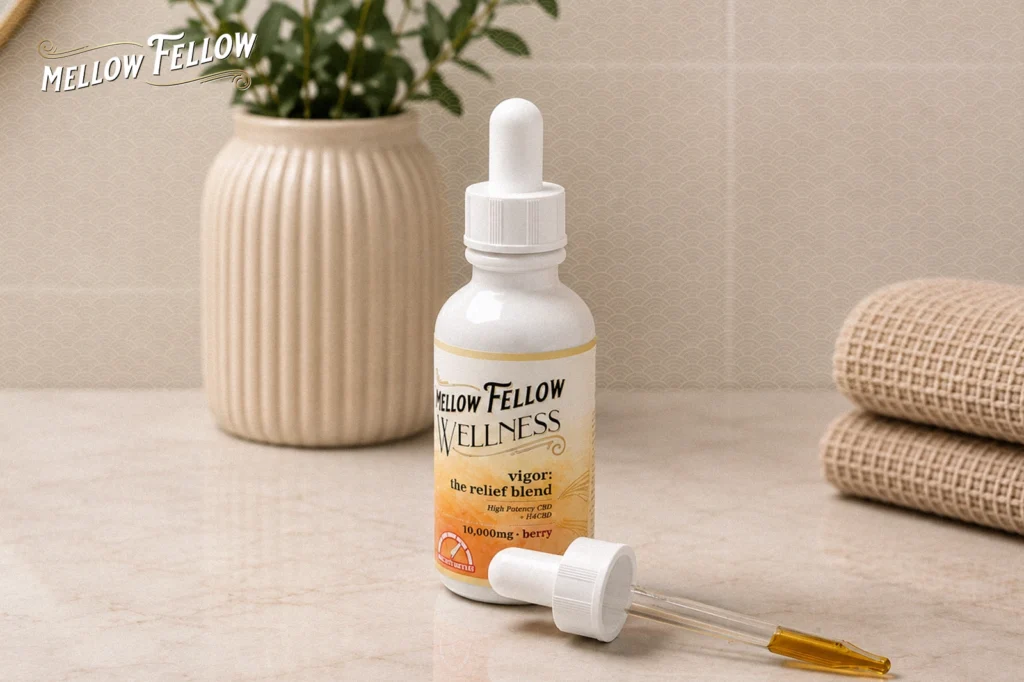
A CBD tincture is a liquid extract, usually CBD dissolved in a carrier oil like MCT oil, sold with a dropper for measured dosing. You place drops under your tongue, hold them there for 30 to 60 seconds, and swallow.
That short hold time matters. The tissue under the tongue is thin and richly supplied with blood vessels, which lets some of the CBD move directly into the bloodstream before digestion ever starts. For a full walkthrough of how this format works and what to expect from the taste and texture, see our guide on what CBD tinctures actually are.
What Is a CBD Softgel Capsule?
A CBD softgel is a soft, swallowable capsule that encloses CBD oil in a gelatin shell. Unlike a tincture, a softgel is designed to be swallowed whole rather than held in the mouth. The shell dissolves in the stomach, and the CBD is absorbed along with everything else you eat, then processed by the liver before it circulates.
This is the same basic mechanism used in other cannabinoid capsules. Our breakdown of how THCV capsules move through the body covers the digestion-first pathway in more detail, and the same principle applies to CBD softgels.
CBD Tinctures vs Softgels: Onset and Duration
The biggest practical difference between these two formats comes down to timing. A 2026 pharmaceutical review in AAPS PharmSciTech found that oral CBD carries absolute bioavailability of roughly 6 to 19%, largely because of poor water solubility and extensive first-pass metabolism in the liver, the same process that slows down softgels.
| Factor | CBD Tincture (Sublingual) | CBD Softgel (Oral) |
| Onset time | 15 to 45 minutes | 45 to 90 minutes |
| Duration of effects | 4 to 6 hours | Often 6 hours or longer |
| Dosing method | Dropper, adjustable by the drop | Fixed milligrams per capsule |
| Taste | Earthy or herbal, unless flavored | None, shell masks the oil |
| Best for | Fast, flexible adjustments | Set-and-forget consistency |
Duration works in the softgel’s favor even though onset is slower. Because digestion releases CBD more gradually, softgels tend to provide a longer, steadier presence in the body once they finally kick in.
Does Sublingual Absorption Really Win?
Conventional wisdom says sublingual always beats swallowing for speed, and it usually does when the tincture is held correctly. A 2023 randomized crossover trial published in Cannabis and Cannabinoid Research is worth knowing about here, because it compared CBD oil taken as sublingual drops against the same oil in gelatin capsules and found no statistically significant difference in peak concentration, time to peak, or total absorption between the two groups. The researchers concluded that much of the sublingual dose was likely swallowed before mucosal absorption had a chance to occur, meaning it behaved like an oral dose anyway.
That finding does not erase the format differences. It does mean a handful of variables decide how much of a “sublingual advantage” you actually get:
- Hold Time: A tincture held for the full 30 to 60 seconds absorbs more through the tissue under the tongue than one swallowed after a quick five-second hold.
- Fasted vs Fed State: Taking CBD with a fat-containing meal can meaningfully raise blood levels for either format, since CBD is fat-soluble.
- Formulation Technology: A 2019 study in Molecules found that a self-emulsifying capsule formulation produced a 4.4-fold higher peak concentration and reached peak levels three hours faster than a standard MCT oil capsule, showing that not all softgels behave the same way.
- Individual Metabolism: Liver enzyme activity varies from person to person, which is part of why CBD’s bioavailability data shows such wide individual swings in both formats.
Dosing Control and Daily Routine Fit
Beyond speed, the practical question is which format fits into your actual day. A dropper bottle lets you split doses, taper up slowly, or add half a milliliter to fine-tune how you feel. A softgel gives up that flexibility in exchange for a dose that never needs measuring, which matters if mornings are rushed or travel is involved.
| Scenario | Better Fit | Why |
| Adjusting your dose while you find what works | Tincture | Dropper allows small, precise changes |
| Grabbing a dose on the way out the door | Softgel | No measuring, no spilling |
| Traveling through airport security or work | Softgel | Sealed capsule, no liquid limits |
| Mixing CBD into coffee or a smoothie | Tincture | Liquid blends into food and drinks |
| Sensitivity to earthy or herbal flavor | Softgel | Shell fully masks the taste |
| Wanting effects before a stressful moment | Tincture | Faster sublingual onset window |
Matching Your Goal to a Format
Different use cases point toward different formats. Here are a few common goals and the format that tends to serve each one best:
- Occasional Stress Before an Event: A tincture’s faster window makes it easier to time relief around something specific, like a presentation or a flight.
- Consistent Nightly Wind-Down: Softgels pair well with a bedtime routine since you can take one alongside brushing your teeth with zero measuring involved. Our guide on how CBD tinctures support sleep also applies here if you prefer the sublingual route at night.
- Managing Recurring Discomfort: Many people managing ongoing discomfort lean on tinctures for the ability to titrate dose day by day. Our guide to CBD tinctures for pain-related use walks through dosing frameworks in more detail.
- Morning or Midday Focus Support: Since timing changes how CBD fits your schedule, a softgel taken with breakfast can quietly carry through a work day without a second thought.
There is no rule against using both. Many people keep a softgel in a travel bag for consistency and a tincture at home for days that call for faster, adjustable relief.
Checking Quality Before You Buy Either One
Format only matters if the product inside actually contains what the label claims. A 2022 lab analysis published in the Journal of Cannabis Research tested 80 commercial CBD oil products and found that only 54% fell within 10% of their advertised potency, with the rest containing meaningfully more or less CBD than the label stated. That is a coin-flip level of accuracy across the unregulated market, regardless of whether the product is a tincture or a softgel.
The FDA has echoed the same concern from its own testing, noting that some CBD products it evaluated did not contain the levels of CBD they advertised and that manufacturing quality varies widely across the category. Before buying either format, look for a batch-specific Certificate of Analysis (COA) from a third-party lab, not just a general claim of “lab tested.”
It is also worth knowing that federal hemp rules are shifting. Under P.L. 119-37, signed into law in November 2025, the federal definition of hemp is set to tighten starting in November 2026, which will affect how some hemp-derived cannabinoid products can legally be sold and labeled going forward. This mostly concerns higher-potency and synthetically converted cannabinoids rather than standard full-spectrum or broad-spectrum CBD, but it is a good reason to keep buying from brands that publish current, batch-level lab results.
Picking the CBD Format That Fits Your Day
CBD tinctures vs softgels is not a contest with one universal winner. Tinctures reward you with speed and a dropper you can adjust in small increments, which suits anyone still dialing in a dose or chasing relief before something specific. Softgels trade a slower start for a fixed dose that fits into a bag, a desk drawer, or a bedtime routine without any measuring at all.
Whichever format you land on, the label accuracy data above is the real deciding factor for safety and consistency. Mellow Fellow’s lineup is built around that standard, with batch-tested CBD tinctures and softgel-style wellness capsules backed by published lab results you can check before you buy. Head to the Mellow Fellow shop to compare current options, or start at the Mellow Fellow homepage to see the full lineup of hemp-derived wellness products.
Frequently Asked Questions
Are CBD Tinctures Better Than CBD Softgels?
Neither format is universally better. Tinctures work faster and allow finer dosing control, while softgels offer a fixed, no-measuring dose with a longer tail of effects. The better choice depends on how quickly you need relief and how much you want to fine-tune your dose.
How Long Do CBD Softgels Take to Work Compared to Tinctures?
Softgels typically take 45 to 90 minutes since the capsule must dissolve and digest before absorption. Tinctures held under the tongue for 30 to 60 seconds often produce effects in 15 to 45 minutes, though a 2023 study found the gap narrows once digestion time is accounted for.
Can I Switch Between a CBD Tincture and a CBD Softgel?
Yes. Many people use a tincture for flexible, situational dosing and a softgel for routine daily use. Since both deliver the same cannabinoid, switching mainly changes onset time and dosing convenience, not the type of CBD you are taking.
Do CBD Softgels Have Less Bioavailability Than Tinctures?
Not necessarily. A 2023 crossover trial found comparable blood CBD levels between sublingual drops and swallowed capsules of the same formulation. Bioavailability depends more on the oil carrier and formulation technology than on whether the product is technically a tincture or a softgel.
Are CBD Tinctures or Softgels Better for Beginners?
Softgels are often easier for first-time users because the dose is pre-measured and consistent from one capsule to the next. Tinctures require using a dropper accurately, which some beginners find fiddly until they get used to it.
Is It Safe to Take CBD Tinctures and Softgels Together?
Combining formats is common and is considered safe by most users when total daily CBD intake stays within a reasonable range, but it is worth tracking your combined dose so you do not unintentionally double up. Our CBD dosage chart for getting started covers how to add up milligrams across formats, including softgels. Check with a healthcare provider if you take other medications.
Sources
- Cannabinoid Oral Mucosal Delivery: Approaches to Formulation, Fabrication, and Permeation Enhancement (2026)
- Cannabidiol Oil Ingested as Sublingual Drops or Within Gelatin Capsules Shows Similar Pharmacokinetic Profiles in Healthy Males (2023)
- A Novel Self-Emulsifying Drug Delivery System (SEDDS) Based on VESIsorb Formulation Technology Improving the Oral Bioavailability of Cannabidiol in Healthy Subjects (2019)
- Label Accuracy of Unregulated Cannabidiol (CBD) Products: Measured Concentration vs. Label Claim (2022)
- What You Need to Know (And What We’re Working to Find Out) About Products Containing Cannabis or Cannabis-derived Compounds, Including CBD (2020)
- Change to Federal Definition of Hemp and Implications for Federal Enforcement (2025)
Leave a Reply